
Sea Buckthorn Benefits: Skin, Hair, Omega 7, Uses, Dosage & Side Effects
Sea buckthorn is gaining attention in modern nutrition, particularly among people searching for supplements for skin, hair and everyday wellness.
The bright orange berries of Hippophae rhamnoides naturally contain a distinctive combination of fatty acids, carotenoids, tocopherols and other plant compounds.
One nutrient has attracted particular attention:
Omega-7.
But what are the real benefits of sea buckthorn? Is it actually good for skin and hair? What’s the difference between sea buckthorn oil and capsules? How much should you take? And are there any side effects?
This guide explains what current research tells us—and where popular online claims go beyond the evidence.
Looking for sea buckthorn in a convenient capsule format?
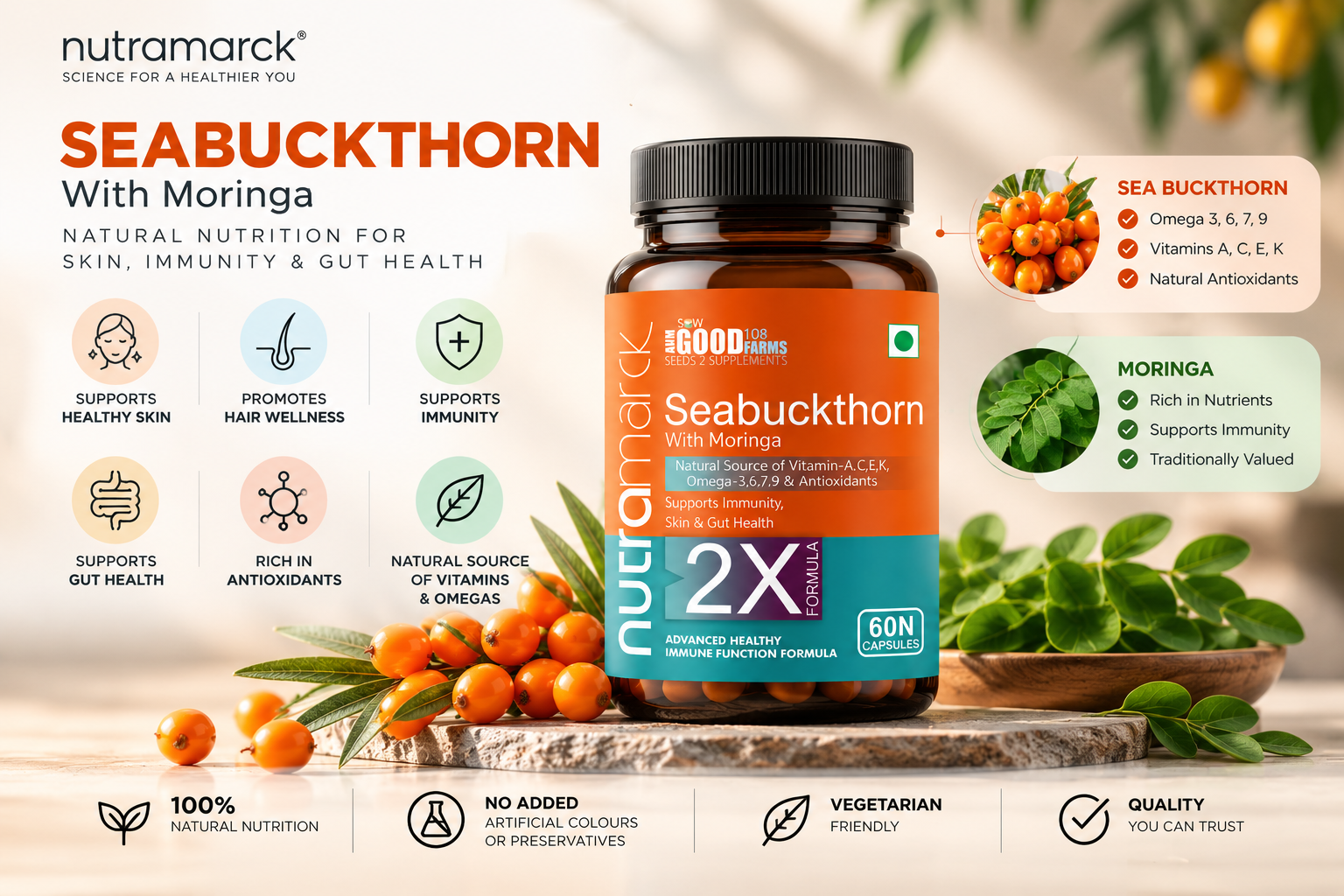
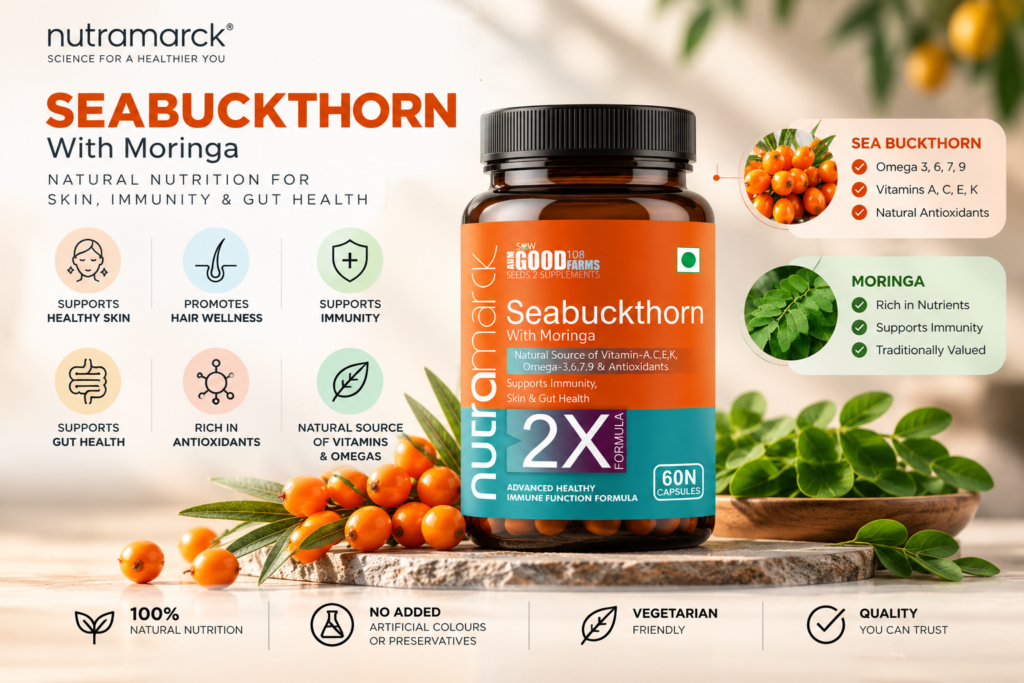
Explore NutraMarck Sea Buckthorn + Moringa Capsules
What Is Sea Buckthorn?
Sea buckthorn is a thorny shrub that produces distinctive orange-yellow berries.
Its botanical name is Hippophae rhamnoides.
Different parts of the plant have traditionally been used, while modern supplements may contain ingredients derived from the:
- Berry
- Fruit pulp
- Seed
- Seed oil
- Pulp oil
- Extract
This distinction matters because different parts of sea buckthorn can have substantially different nutritional compositions.
Sea buckthorn may naturally provide various:
Fatty acids → Carotenoids → Tocopherols → Phytosterols → Polyphenols
The exact concentrations depend on factors including plant variety, growing conditions, extraction process and which part of the berry is used.
Why Is Sea Buckthorn Becoming So Popular?
One reason is its unusual lipid profile.
Consumers increasingly search for sea buckthorn in relation to:
- Skin wellness
- Dry skin
- Hair wellness
- Omega-7
- Women’s wellness
- Healthy ageing
- Antioxidant nutrition
- General wellness
However, popularity does not mean every claim made about sea buckthorn has strong human clinical evidence.
Understanding what sea buckthorn actually contains is therefore the best place to start.
What Is Omega-7?
Omega-7 refers to a family of monounsaturated fatty acids.
One of the best-known Omega-7 fatty acids is:
Palmitoleic Acid
Sea buckthorn—particularly certain pulp-derived oils—is a notable botanical source of palmitoleic acid.
This is why sea buckthorn is frequently marketed as an Omega-7 source.
But sea buckthorn’s lipid profile is more complicated than Omega-7 alone.
Depending on the part of the plant and preparation, sea buckthorn oils may contain varying proportions of:
- Omega-3
- Omega-6
- Omega-7
- Omega-9
This is where the popular description “Omega 3-6-7-9” comes from.
However, consumers should not assume every sea buckthorn product contains identical amounts of each fatty acid.
Sea Buckthorn Benefits
Sea buckthorn has been investigated in several areas of nutrition and health.
Some areas have limited but interesting human research, while others rely more heavily on laboratory, animal or traditional-use evidence.
The most responsible approach is therefore to distinguish between:
Potential nutritional support
and
proven medical treatment.
They are not the same thing.
1. Sea Buckthorn Benefits for Skin
Skin health is probably one of the most commercially interesting areas for sea buckthorn.
Your skin barrier contains lipids that play an important role in maintaining its normal structure and moisture balance.
Because sea buckthorn contains several fatty acids and antioxidant-related compounds, researchers have investigated its potential relationship with skin health.
Small human studies using sea buckthorn preparations have reported changes in certain skin-related measurements.
This makes sea buckthorn an interesting ingredient for beauty-from-within nutrition.
However, this does not mean sea buckthorn can treat eczema, psoriasis, acne or other skin diseases.
A more evidence-conscious way to position it is:
Sea Buckthorn → Nutritional Skin Support
rather than:
Sea Buckthorn → Skin Disease Treatment
For people who prefer capsules instead of using liquid sea buckthorn oil separately:
View NutraMarck Sea Buckthorn + Moringa Capsules
2. Sea Buckthorn and Skin Hydration
Dry skin can have many causes.
These include:
- Environmental conditions
- Age
- Skin-care routine
- Diet
- Certain medications
- Skin-barrier changes
- Medical conditions
Because sea buckthorn contains fatty acids, researchers have been interested in whether oral supplementation could influence skin moisture or barrier-related characteristics.
This is one reason sea buckthorn appears increasingly in supplements positioned around skin nourishment and healthy ageing.
However, supplementation should complement—not replace—basic skin care.
Regular moisturisation, sun protection, adequate nutrition and appropriate medical care remain important.
3. Sea Buckthorn Benefits for Hair
“Sea buckthorn for hair growth” is another popular search topic.
This requires careful interpretation.
Sea buckthorn provides fatty acids and various plant compounds that can form part of overall nutrition.
But there is currently insufficient evidence to claim that taking sea buckthorn capsules will reliably:
stop hair loss
reverse baldness
or
regrow lost hair.
Hair health is influenced by numerous factors, including:
- Protein intake
- Iron status
- Zinc status
- Genetics
- Hormones
- Thyroid function
- Stress
- Age
- Scalp health
Therefore, sea buckthorn is better positioned as part of general nutritional wellness rather than as a hair-loss treatment.
4. Sea Buckthorn Contains Naturally Occurring Antioxidant Compounds
Sea buckthorn berries contain several plant compounds associated with antioxidant activity.
These can include:
- Carotenoids
- Tocopherols
- Polyphenolic compounds
Antioxidants participate in protecting cells against oxidative damage.
However, the word “antioxidant” is often overused.
It does not automatically mean a food or supplement can:
- Stop ageing
- Cure disease
- Prevent cancer
- “Detox” the entire body
Those are much stronger claims and require much stronger evidence.
5. Sea Buckthorn and Omega Fatty Acids
Sea buckthorn’s unusual fatty-acid profile is one of its most interesting nutritional characteristics.
But not all sea buckthorn oils are identical.
Sea Buckthorn Seed Oil
Seed oil generally has a different fatty-acid profile and can contain substantial amounts of polyunsaturated fatty acids such as omega-3 and omega-6.
Sea Buckthorn Pulp Oil
Pulp oil can be particularly notable for palmitoleic acid, an Omega-7 fatty acid.
Therefore, when comparing products, don’t look only for the words:
“Sea Buckthorn Oil.”
Also investigate:
Seed or Pulp? → Amount → Processing → Complete Formula
6. Sea Buckthorn Benefits for Women
Sea buckthorn is frequently marketed toward women.
Popular areas include:
- Skin wellness
- Hair wellness
- Healthy ageing
- Dryness
- Menopause-related wellness
One interesting area of clinical research has investigated oral sea buckthorn oil in postmenopausal women experiencing vaginal dryness.
A randomized controlled study reported changes in certain measures related to vaginal epithelial integrity.
This makes the topic scientifically interesting.
However, this should not be translated into the claim:
“Sea buckthorn treats menopause.”
Menopause involves many physiological changes and symptoms.
Persistent dryness, pain, bleeding or other symptoms should be discussed with an appropriate healthcare professional.
7. Sea Buckthorn Benefits for Men
Sea buckthorn isn’t a women-only ingredient.
Its fatty acids and plant compounds are not sex-specific.
Men may also use sea buckthorn as part of a broader nutritional wellness routine.
However, evidence does not justify exaggerated claims that sea buckthorn will automatically:
- Boost testosterone dramatically
- Increase muscle mass
- Treat erectile dysfunction
- Transform male hormones
These claims should be avoided unless supported by appropriate product-specific evidence.
8. Sea Buckthorn and Healthy Ageing
Sea buckthorn is increasingly associated with healthy-ageing products because it provides a combination of lipids and plant compounds.
But “anti-ageing” can easily become an exaggerated marketing term.
Ageing is a complex biological process influenced by:
Genetics + Diet + Exercise + Sleep + Sun Exposure + Smoking + Alcohol + Metabolic Health + Environment
No single berry or supplement can stop this process.
Sea buckthorn can instead be viewed as one ingredient within an overall healthy lifestyle.
Sea Buckthorn Oil vs Capsules
This is an important question when choosing a supplement.
But there’s a common misunderstanding:
“Capsule” describes the dosage form—not necessarily the ingredient inside it.
A sea buckthorn capsule could contain:
- Sea buckthorn oil
- Berry powder
- Extract
- Seed oil
- Pulp oil
- A combination formula
Therefore, asking:
“Oil or capsule?”
is less useful than asking:
“What exactly does this capsule contain?”
Looking for Sea Buckthorn Capsules?
For people who prefer a convenient capsule format, NutraMarck combines Sea Buckthorn + Moringa in one formulation.
Before choosing any supplement, check the complete ingredient list and recommended serving information on the product page.
Shop NutraMarck Sea Buckthorn + Moringa Capsules
Sea Buckthorn Berry vs Seed Oil
Another common mistake is treating every part of the plant as nutritionally identical.
They’re not.
Berry / Pulp
Can contain carotenoids and a distinctive lipid profile, including Omega-7-rich components depending on the preparation.
Seed
Typically has a different fatty-acid composition, including polyunsaturated fatty acids.
Therefore, two supplements labelled “Sea Buckthorn” may provide quite different nutritional profiles.
Sea Buckthorn vs Fish Oil
Sea buckthorn should not be considered identical to fish oil.
Fish oil is primarily valued for the long-chain omega-3 fatty acids:
EPA + DHA
Sea buckthorn has a different fatty-acid profile and is particularly interesting because certain preparations contain Omega-7/palmitoleic acid.
Therefore:
Sea Buckthorn ≠ Fish Oil
They serve different nutritional purposes.
Sea Buckthorn vs Omega-3
Sea buckthorn and Omega-3 are also not synonymous.
Omega-3 describes a family of fatty acids.
Sea buckthorn is a botanical ingredient that may contain multiple types of fatty acids depending on the plant part and preparation.
Someone specifically seeking EPA and DHA should not automatically replace fish or algae-derived omega-3 with sea buckthorn.
Sea Buckthorn + Moringa
Sea buckthorn and moringa are two different botanical ingredients.
Sea buckthorn is particularly interesting because of its fatty acids and naturally occurring plant compounds.
Moringa (Moringa oleifera) contains its own range of naturally occurring phytonutrients.
Combining botanical ingredients can create a broader formulation, but more ingredients do not automatically mean a product is better.
The important questions remain:
What ingredients are present?
How much is provided?
Is the label transparent?
Does the formulation suit your needs?
You can review the complete NutraMarck formulation here:
See Sea Buckthorn + Moringa Capsule Details
How Much Sea Buckthorn Should You Take?
There is no single universal sea buckthorn dosage suitable for every product.
This is because supplements differ substantially.
One may contain:
Oil
another:
Berry powder
another:
Extract
and another:
Sea buckthorn combined with additional botanical ingredients.
Research studies have also used different preparations and doses.
Therefore, the appropriate serving should be based on:
Specific formulation + Product directions + Individual circumstances
More is not automatically better.
Best Time to Take Sea Buckthorn
There is no scientifically established universal “best hour” to take sea buckthorn.
For most supplements, consistent use according to product directions is more important than trying to find a perfect time.
If the product contains oil or other lipid-based components, taking it with a meal may be practical depending on the specific formulation and directions.
Always follow the product label.
How Long Does Sea Buckthorn Take to Work?
There is no universal scientifically established timeframe.
Results—if any—can depend on:
- The outcome being measured
- Ingredient source
- Product formulation
- Amount consumed
- Diet
- Consistency
- Individual physiology
- Baseline nutritional status
Be cautious with claims such as:
“Perfect skin in 3 days.”
or
“Hair regrowth in one week.”
Such promises require strong product-specific evidence.
Sea Buckthorn Side Effects
Sea buckthorn foods and supplements are tolerated by many people, but that does not mean every supplement is suitable for everyone.
Some people may experience digestive discomfort or individual sensitivity.
Extra caution is sensible if you:
- Take prescription medication
- Have an ongoing medical condition
- Are preparing for surgery
- Are pregnant
- Are breastfeeding
- Have known botanical allergies
If you experience an unexpected reaction after taking a supplement, discontinue it and seek appropriate professional advice when necessary.
Can You Take Sea Buckthorn Every Day?
Sea buckthorn preparations have been consumed daily in some research settings.
However, this does not establish one universal daily amount for every sea buckthorn product.
The correct approach is to follow the serving instructions of the specific formulation you’re using.
If you intend to use supplements long term and have an underlying medical condition or take medication, professional guidance may be appropriate.
Is Sea Buckthorn Good for Fatty Liver?
Sea buckthorn is sometimes promoted online as a “liver detox.”
That claim needs caution.
Fatty liver disease is influenced by multiple factors including:
- Insulin resistance
- Excess body weight
- Type 2 diabetes
- Blood lipids
- Diet
- Physical activity
- Alcohol exposure
- Genetics
A sea buckthorn supplement should not be presented as a treatment or cure for fatty liver disease.
Lifestyle and medical management depend on the individual’s condition and risk factors.
Does Sea Buckthorn Help With Weight Loss?
There is not sufficient evidence to promise that sea buckthorn alone produces meaningful weight loss.
Body-fat reduction depends much more heavily on:
Energy balance + Diet + Physical activity + Sleep + Metabolic health
Be cautious with supplements promising rapid fat loss simply because they contain a botanical ingredient.
Is Sea Buckthorn Good for Immunity?
Sea buckthorn contains nutrients and plant compounds, but phrases such as “boosts immunity” are often used too casually.
The immune system is complex.
Normal immune function depends on many factors, including:
- Adequate nutrition
- Protein
- Vitamins and minerals
- Sleep
- Physical activity
- General health
Sea buckthorn is better viewed as part of overall nutrition rather than as an instant immune-system booster.
Sea Buckthorn and Moringa: What Is the Difference?
These are different plants.
Sea Buckthorn
Particularly interesting for its unusual fatty-acid profile and various plant compounds.
Moringa
A nutrient-rich botanical containing various naturally occurring phytochemicals.
Neither ingredient should be marketed as a miracle cure.
A combination supplement should be judged by its complete formulation, not simply by the number of ingredients listed on the front.
How to Choose the Best Sea Buckthorn Supplement
Before buying sea buckthorn, consider five things.
1. Check the Ingredient Source
Is it:
Berry? Seed? Pulp? Oil? Powder? Extract?
These are not automatically interchangeable.
2. Check the Amount Per Serving
Don’t rely only on the largest number printed on the front.
Read the actual serving information.
3. Check the Complete Formula
If the supplement combines sea buckthorn with other ingredients, understand what those ingredients are.
4. Look for Transparent Labelling
Clear ingredient information is more valuable than exaggerated marketing claims.
5. Consider Manufacturing Quality
Ingredient identity, manufacturing controls and product quality matter for botanical supplements.
For an example of a combined sea buckthorn formulation:
Check NutraMarck Sea Buckthorn + Moringa Capsules
Food First or Supplement First?
Supplements should complement a balanced diet.
For overall skin, hair and wellness, the fundamentals remain important:
Adequate Protein
Essential Fatty Acids
Fruits & Vegetables
Micronutrients
Hydration
Sleep
Physical Activity
Sun Protection
A supplement can be one component of your wellness routine.
It should not become a replacement for the basics.
Frequently Asked Questions About Sea Buckthorn
What are the main sea buckthorn benefits?
Sea buckthorn provides fatty acids and naturally occurring plant compounds. Research has investigated potential roles in areas including skin and mucosal health, although the strength of evidence varies by outcome.
Is sea buckthorn good for skin?
Sea buckthorn’s fatty-acid profile and plant compounds have led to research into skin-related outcomes. Some small human studies are promising, but sea buckthorn should not be considered a treatment for skin disease.
Does sea buckthorn help hair growth?
There isn’t sufficient clinical evidence to claim sea buckthorn reliably regrows hair or treats hair loss.
What is Omega-7 in sea buckthorn?
Omega-7 commonly refers to palmitoleic acid, a monounsaturated fatty acid found in certain sea buckthorn preparations, particularly pulp-derived oil.
Does sea buckthorn contain Omega 3, 6, 7 and 9?
Sea buckthorn oils can contain several fatty acids, but their proportions vary depending on the plant part, variety and extraction method. Not every sea buckthorn supplement has an identical Omega 3-6-7-9 profile.
Is sea buckthorn oil better than capsules?
Not necessarily. A capsule can itself contain oil or another sea buckthorn preparation. Compare the actual ingredient, source and amount rather than simply the dosage form.
What are sea buckthorn benefits for women?
Sea buckthorn has been investigated for skin and mucosal health, including limited clinical research involving postmenopausal women. It should not be marketed as a treatment for menopause.
Can men take sea buckthorn?
Yes. Its nutritional components are not female-specific.
What is the best time to take sea buckthorn?
There is no universally established best time. Follow the specific product directions and prioritize consistency.
Can I take sea buckthorn daily?
Some sea buckthorn preparations have been used daily in research, but dosage and formulation vary. Follow the directions of the specific product.
Is sea buckthorn good for weight loss?
Current evidence is insufficient to claim that sea buckthorn alone causes significant weight loss.
Does sea buckthorn detox the liver?
“Liver detox” is an oversimplified marketing concept. Sea buckthorn should not be used as a substitute for medical evaluation or treatment of liver disease.
What is better: sea buckthorn or moringa?
They are different botanicals with different nutritional profiles, so there is no universal “better” option. The choice depends on the formulation and nutritional goal.
The Bottom Line
Sea buckthorn is an interesting botanical because it contains a distinctive combination of fatty acids, carotenoids and other plant compounds, with particular attention given to Omega-7/palmitoleic acid in certain preparations.
Research into skin and mucosal health is interesting, but many claims online extend beyond the available clinical evidence.
Instead of looking for a miracle ingredient, ask:
What part of sea buckthorn is being used?
What does the supplement actually contain?
How much does it provide?
What other ingredients are included?
Are the claims realistic?
That’s a much better way to evaluate a supplement.
Add Sea Buckthorn to Your Daily Wellness Routine
For people looking for sea buckthorn in a convenient capsule format, explore NutraMarck Sea Buckthorn + Moringa Capsules and review the complete formulation, serving information and product directions before deciding whether it suits your routine.



Add comment