
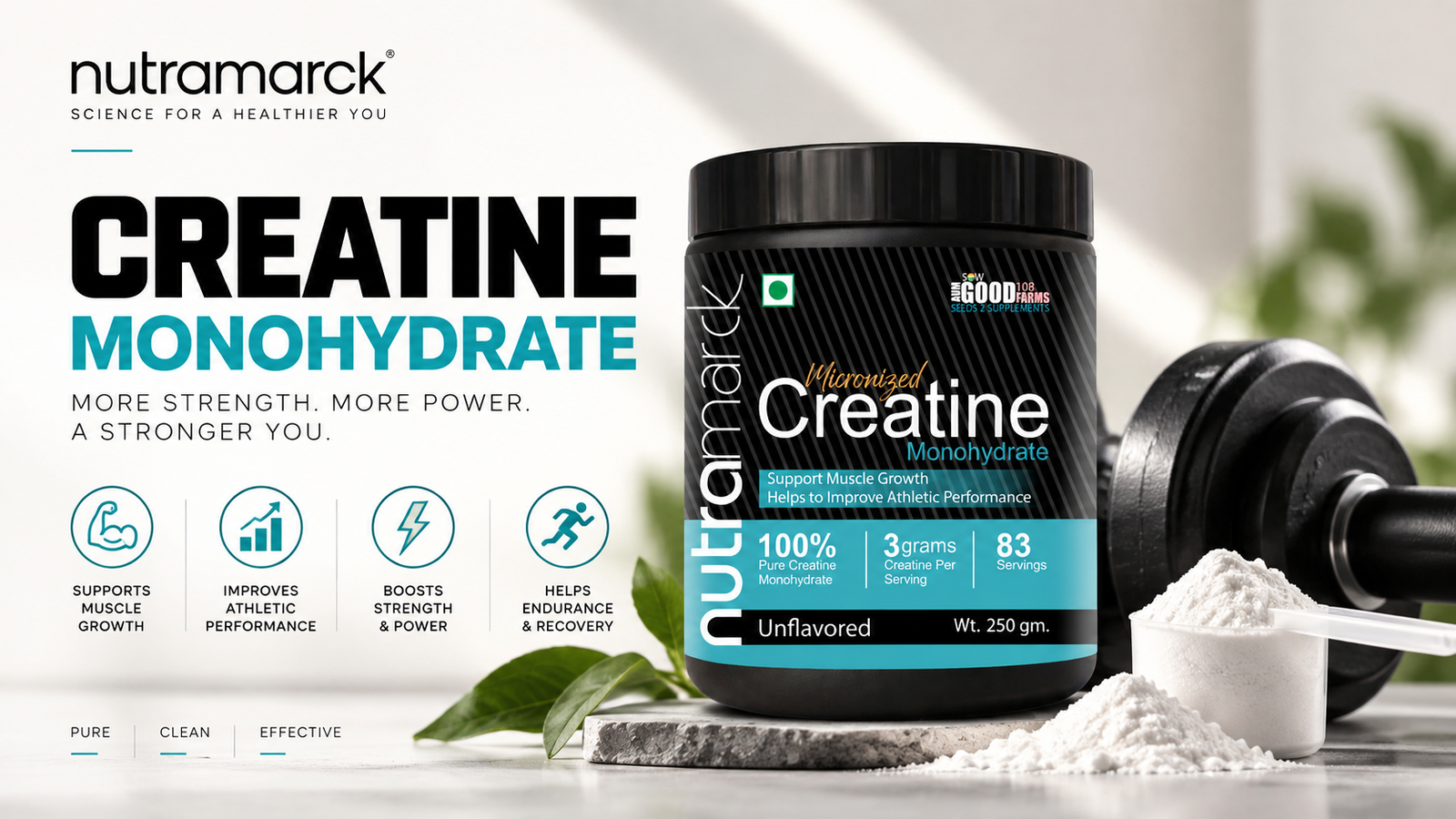
Creatine Monohydrate Benefits: Dosage, Muscle Gain, Best Time & Side Effects
Creatine is one of the most researched ingredients in sports nutrition, yet it remains surrounded by questions.
Does creatine actually help build muscle? Should you take it before or after a workout? Does creatine cause weight gain or hair loss? Is it suitable for women? Do beginners need a loading phase?
And with so many types of creatine available, which one should you choose?
This complete guide explains creatine monohydrate benefits, dosage, timing, muscle gain, loading, side effects and safety using current scientific evidence.
What Is Creatine?
Creatine is a naturally occurring compound involved in the body’s energy system.
Your body can produce creatine from amino acids, while some creatine is also obtained through foods—particularly meat and fish.
Most of the body’s creatine is stored in skeletal muscle.
Inside muscle cells, creatine helps maintain phosphocreatine, which assists in rapidly regenerating ATP.
ATP—adenosine triphosphate—is an immediate source of cellular energy.
This becomes particularly important during short bursts of intense activity such as:
- Weight training
- Sprinting
- Jumping
- Heavy lifting
- Repeated high-intensity exercise
This is one reason creatine has become so popular among athletes, gym-goers and people following resistance-training programs.
What Is Creatine Monohydrate?
There are several forms of creatine available, including:
- Creatine Monohydrate
- Creatine HCl
- Buffered Creatine
- Creatine Ethyl Ester
- Creatine Nitrate
- Micronized Creatine Monohydrate
However, creatine monohydrate is the most extensively studied form and remains the standard against which alternative forms are compared.
More expensive or more technical-sounding creatine forms are not automatically better.
For most people looking for a straightforward, research-backed option, creatine monohydrate remains a sensible choice.
Looking for a simple creatine monohydrate powder for your training routine?
Explore NutraMarck Creatine Monohydrate Powder 250g
7 Potential Creatine Monohydrate Benefits
1. Supports Muscle Strength
One of the strongest areas of creatine research is muscular strength.
Creatine helps increase phosphocreatine availability in muscle, supporting rapid ATP regeneration during high-intensity muscular contractions.
When combined with resistance training, this can help support performance during heavy or explosive exercise.
Creatine is therefore particularly relevant for activities such as:
Weight Training → Powerlifting → Sprinting → High-Intensity Sports
2. Supports High-Intensity Exercise Performance
Creatine is particularly useful for repeated bouts of short-duration, high-intensity exercise.
Examples include:
- Heavy gym sets
- Sprint intervals
- Explosive movements
- Repeated jumps
- High-intensity team sports
Creatine should not simply be described as a generic “energy supplement.”
Its strongest performance evidence relates to short-duration, repeated high-intensity activity.
3. Supports Muscle Gain With Resistance Training
This is one of the biggest reasons people search for creatine.
But creatine does not magically create muscle.
Instead, supplementation can help support high-intensity training capacity.
Over time, improved training quality combined with adequate nutrition and recovery can contribute to better training adaptations.
Think:
Creatine + Resistance Training + Protein + Nutrition + Recovery
—not creatine alone.
4. Supports Training Capacity
Creatine may help you perform repeated high-intensity efforts during training.
Over weeks and months, this can support the amount and quality of work performed during a structured resistance-training program.
The important distinction is:
Creatine supports training. It does not replace training.
5. Supports Power & Explosive Performance
Power depends on producing force quickly.
Because the phosphocreatine system is particularly important during short bursts of intense activity, creatine is commonly used in sports requiring repeated explosive movements.
This may include sprinting, jumping and strength-based activities.
6. May Support Exercise Recovery
Creatine helps replenish the phosphocreatine energy system between intense efforts.
This can be useful when training involves repeated sets or bouts of high-intensity activity.
However, creatine cannot replace:
- Adequate sleep
- Rest days
- Sufficient calories
- Protein
- Hydration
- Proper training programming
7. Creatine Is Also Being Studied Beyond Muscle
Creatine isn’t found only in skeletal muscle.
The brain also requires considerable energy, which has led researchers to study creatine in relation to cognition and brain energy metabolism.
Some research has reported potential benefits for certain cognitive outcomes, while findings remain inconsistent across populations and outcomes.
Therefore, creatine’s evidence for strength and high-intensity exercise is currently more established than broad claims about cognitive enhancement.
Creatine for Muscle Gain
Does creatine increase muscle size?
It can support increases in lean mass when combined with resistance training.
But two different processes should be understood.
Early Weight Increase
Creatine can increase water content associated with muscle.
Therefore, some people notice their body weight increase relatively quickly after beginning supplementation.
Longer-Term Training Adaptation
By helping support training performance and capacity, creatine can contribute to an environment that supports muscle development when combined with appropriate resistance training and nutrition.
So an increase on the weighing scale after starting creatine does not automatically mean all of that weight is new muscle tissue.
Creatine Dosage: How Much Should You Take?
One of the most commonly researched maintenance ranges is:
3–5 g Creatine Monohydrate Per Day
There are two common strategies.
Option 1: Creatine Without Loading
A straightforward approach is approximately:
3–5 g per day
taken consistently.
Muscle creatine stores gradually increase over time.
For many people, this is the simplest strategy.
Option 2: Creatine Loading Phase
A commonly studied loading strategy is approximately:
20 g per day for 5–7 days
usually divided into four smaller servings of around:
5 g × 4
This is then followed by a maintenance intake such as:
3–5 g per day.
Is Creatine Loading Necessary?
No.
Loading can increase muscle creatine stores faster, but it isn’t mandatory.
Consistently taking a smaller daily amount can also increase muscle creatine stores over time.
If you prefer simplicity:
Daily consistency matters more than having a loading phase.
Best Time to Take Creatine
One of the most searched questions is:
When is the best time to take creatine?
Before workout?
After workout?
Morning?
At night?
For most people, the exact clock time is less important than consistent daily supplementation.
Creatine does not work like a stimulant that suddenly “kicks in” after one serving.
Its benefits are primarily related to maintaining elevated muscle creatine stores.
Creatine Before or After Workout?
Either approach can fit into your routine.
If adding creatine to your post-workout shake helps you remember it, that is practical.
If taking it with breakfast means you’re more consistent, that can also work.
A useful principle is:
Consistency > Perfect Timing
Should You Take Creatine Every Day?
Creatine is generally taken consistently, including on rest days, when the goal is maintaining elevated muscle creatine stores.
You don’t need to wait until immediately before your workout.
Training Day
Take your normal daily serving.
Rest Day
Continue your normal daily serving.
Creatine on Rest Days
Yes, creatine can be taken on rest days.
Muscle creatine saturation does not disappear simply because you don’t train for one day.
This is why a consistent routine is usually easier than trying to coordinate creatine only with workout days.
Creatine With Water or Milk?
Creatine powder can be mixed according to the product directions.
Water is the simplest option.
Some people also add creatine to:
- Protein shakes
- Smoothies
- Other suitable beverages
The important factors are appropriate serving size and consistency.
Can You Take Creatine With Whey Protein?
Yes.
Creatine and protein serve different purposes.
Creatine
Supports the phosphocreatine energy system and high-intensity exercise performance.
Protein
Provides amino acids needed for numerous functions, including muscle protein synthesis.
They are not substitutes for one another.
A person can use creatine and protein as part of the same sports-nutrition routine when appropriate.
Creatine vs Whey Protein
This comparison causes unnecessary confusion.
Creatine and whey protein are fundamentally different products.
Creatine Monohydrate: primarily supports high-intensity exercise capacity.
Whey Protein: helps increase dietary protein and provides essential amino acids.
Depending on someone’s diet and training goals, they may use:
Creatine only → Protein only → Both → Neither
Creatine for Beginners
Beginners don’t need a cupboard full of supplements.
Start with the fundamentals:
Progressive Training + Adequate Protein + Appropriate Calories + Sleep + Recovery + Consistency
Once those basics are in place, creatine monohydrate is one of the most researched sports-nutrition ingredients to consider.
A beginner does not need an expensive “advanced creatine stack.”
Creatine for Men
Creatine is commonly used by men interested in:
- Muscle development
- Strength training
- Power
- Sprint performance
- High-intensity sports
But creatine should not be confused with testosterone, hormones or anabolic steroids.
Creatine is not a steroid.
Its primary role relates to cellular energy metabolism.
Creatine for Women
Creatine isn’t a men-only supplement.
Women involved in resistance training and high-intensity exercise can also consider creatine.
The underlying phosphocreatine energy system exists regardless of sex.
Does Creatine Make Women Bulky?
Creatine does not suddenly produce large muscles.
Muscle development depends on many factors, including:
- Training
- Nutrition
- Genetics
- Hormones
- Recovery
- Time
Some early body-weight increase may also be related to water rather than dramatic increases in muscle tissue.
Does Creatine Cause Weight Gain?
Creatine can increase body weight.
A major reason is increased water retention associated with muscle creatine storage.
This is not the same thing as gaining body fat.
Therefore:
Creatine-related weight gain ≠ automatically fat gain.
People focused entirely on the number on the scale should understand this before starting supplementation.
Does Creatine Cause Water Retention?
Creatine can increase water retention.
This is particularly noticeable for some people during the early stages of supplementation or a loading phase.
Again, this does not mean creatine is making you “fat.”
Does Creatine Cause Hair Loss?
This is one of the most persistent creatine myths.
Current evidence does not establish that creatine supplementation causes hair loss.
The concern largely grew from limited research involving changes in DHT, but a change in a hormone marker does not by itself demonstrate that creatine causes baldness.
More importantly:
Creatine → Hair Loss
has not been established as a proven cause-and-effect relationship.
If someone is experiencing significant hair loss, there are many potential causes worth discussing with an appropriate healthcare professional.
Is Creatine Bad for Your Kidneys?
This question requires more nuance than a simple yes or no.
Creatine metabolism produces creatinine.
Creatinine is also commonly measured in blood tests used to assess kidney function.
This means supplementation may affect interpretation of creatinine-related laboratory results in some circumstances.
That is not automatically equivalent to kidney damage.
Creatine monohydrate has a substantial safety record in healthy adults when used at commonly studied doses.
However, anyone with:
- Existing kidney disease
- Abnormal kidney tests
- Significant chronic disease
- Relevant medication use
should obtain professional medical advice before starting supplementation.
If you’re having laboratory testing, it is also sensible to tell your healthcare professional about the supplements you use.
Creatine Side Effects
Creatine is generally well tolerated by healthy adults at commonly studied doses.
Potential issues can include:
- Water-related weight gain
- Gastrointestinal discomfort
- Nausea
- Loose stools or diarrhoea, particularly with large single servings
Taking unnecessarily large amounts does not automatically provide better results.
Does Creatine Cause Dehydration?
Creatine is frequently blamed for dehydration or muscle cramps.
Current evidence does not support treating dehydration or cramping as inevitable consequences of creatine use.
Normal hydration is still important—particularly during intense exercise or hot weather—with or without creatine.
Do You Need to Cycle Creatine?
You may see recommendations such as:
8 weeks ON → 4 weeks OFF
There is no universal requirement that healthy adults must follow arbitrary creatine cycling schedules.
Creatine has also been studied using continuous supplementation.
Cycling should not be confused with the optional loading phase, which is a different concept.
What Happens When You Stop Creatine?
If you stop taking creatine, elevated muscle creatine stores gradually move back toward baseline.
Some additional water-related body weight may also decrease.
This does not mean all the muscle you’ve developed through training suddenly disappears.
Your long-term physique still depends primarily on training, nutrition and recovery.
Can You Take Creatine Without Working Out?
Creatine can increase muscle creatine availability even if you aren’t exercising.
However, if your goal is:
muscle + strength + performance
then structured exercise is an essential part of the equation.
Creatine should not be expected to replace resistance training.
Creatine Monohydrate vs Creatine HCl
Creatine HCl is sometimes marketed as:
- Better absorbed
- More advanced
- Less bloating
- More powerful
But marketing claims should not be confused with evidence of superior outcomes.
Creatine monohydrate remains the most extensively studied form.
For most people, there is little reason to reject a well-formulated creatine monohydrate simply because another form sounds more technical.
Micronized Creatine vs Regular Creatine
“Micronized” refers to smaller particle size.
This may help the powder disperse more easily in liquid.
But micronization does not turn creatine into a completely different active ingredient.
Micronized creatine monohydrate is still creatine monohydrate.
Creatine vs BCAA
Creatine and BCAAs serve different purposes.
BCAA stands for branched-chain amino acids:
- Leucine
- Isoleucine
- Valine
Creatine, meanwhile, supports the phosphocreatine energy system.
Someone already consuming sufficient high-quality protein may have less reason to rely heavily on standalone BCAA supplementation.
Creatine and BCAAs should not be considered equivalent products.
Creatine vs Pre-Workout
A typical stimulant-containing pre-workout is designed to produce effects around a workout, often because it contains caffeine.
Creatine is different.
It works primarily by increasing muscle creatine stores over time.
Therefore, you don’t need to feel creatine working immediately after taking it.
How Long Does Creatine Take to Work?
The answer depends partly on how you take it.
With Loading
Muscle creatine stores can increase more rapidly.
Without Loading
A consistent lower daily dose takes longer to achieve similar saturation.
Neither approach means you should expect dramatic muscle growth within a few days.
Creatine works best as part of a consistent training and nutrition routine.
How to Choose the Best Creatine
Don’t choose creatine simply because the packaging makes the biggest claims.
Look for a few fundamentals.
1. Choose a Well-Studied Form
Creatine monohydrate has the strongest overall research history.
2. Check Serving Size
You should clearly understand how much creatine the product provides per serving.
3. Check the Ingredient List
A creatine product does not need dozens of unrelated ingredients to work.
4. Consider Manufacturing Quality
Ingredient identity, purity and manufacturing standards matter.
5. Avoid Miracle Claims
Be cautious with claims such as:
“Gain 10 kg muscle instantly”
“Build muscle without exercise”
“Instant testosterone boost”
“Transform your body in 7 days”
Creatine doesn’t need exaggerated promises—the scientific evidence for its actual role is already substantial.
NutraMarck Creatine Monohydrate Powder
For people looking for a straightforward creatine option as part of their gym, strength or sports-nutrition routine, explore NutraMarck Creatine Monohydrate Powder 250g.
Creatine works best when it is treated as one part of a complete routine rather than a shortcut.
Training → Nutrition → Protein → Creatine → Sleep → Consistency
Explore NutraMarck Creatine Monohydrate Powder 250g
Frequently Asked Questions About Creatine
What are the main creatine monohydrate benefits?
Creatine monohydrate can support strength, power and repeated high-intensity exercise performance. When combined with appropriate resistance training, it can also support training adaptations.
Is creatine good for muscle gain?
Creatine can support muscle-building programs by improving high-intensity training capacity. It is most useful when combined with resistance training, adequate protein, sufficient nutrition and recovery.
How much creatine should I take?
A commonly studied maintenance intake is approximately 3–5 g per day for healthy adults. Individual needs and product directions should still be considered.
Do I need a creatine loading phase?
No. Loading can increase muscle creatine stores faster, but consistent daily supplementation without loading can also increase muscle stores over time.
What is the best time to take creatine?
For most people, consistent daily intake is more important than taking creatine at one exact time of day.
Creatine before or after workout—which is better?
Either can fit into a routine. Creatine’s main effects depend on maintaining muscle creatine stores rather than producing an immediate stimulant effect.
Should I take creatine on rest days?
Creatine is commonly taken consistently on both training and rest days.
Can women take creatine?
Yes. Creatine’s energy-system role is not exclusive to men, and creatine has been studied in women as well.
Does creatine cause weight gain?
Creatine may increase body weight, particularly because of increased water retention. This should not automatically be confused with body-fat gain.
Does creatine cause hair loss?
Current evidence does not establish that creatine supplementation causes hair loss.
Is creatine a steroid?
No. Creatine is not an anabolic steroid.
Does creatine damage the kidneys?
Research supports the safety of commonly studied creatine doses in healthy adults. People with kidney disease, abnormal kidney tests or other significant medical conditions should obtain professional advice before supplementation.
Can I take creatine and whey protein together?
Yes. Creatine and whey protein serve different nutritional purposes and can be used within the same routine when appropriate.
Can beginners take creatine?
Healthy adult beginners may consider creatine, but exercise programming, nutrition, protein intake, sleep and consistency should come first.
Is creatine monohydrate better than creatine HCl?
Creatine monohydrate has a much larger research base. Alternative forms have not consistently demonstrated superior real-world outcomes.
The Bottom Line
Creatine monohydrate doesn’t need complicated marketing.
It is one of the most extensively studied sports-nutrition ingredients and has strong evidence for supporting strength, power and repeated high-intensity exercise performance.
For most healthy adults interested in gym or performance goals, the fundamentals remain simple:
Creatine Monohydrate + Consistent Daily Use + Resistance Training + Adequate Protein + Balanced Nutrition + Recovery
Don’t expect creatine to replace hard training.
Use it to support a training routine that is already built on strong fundamentals.
Ready to add creatine monohydrate to your training routine?






Add comment