
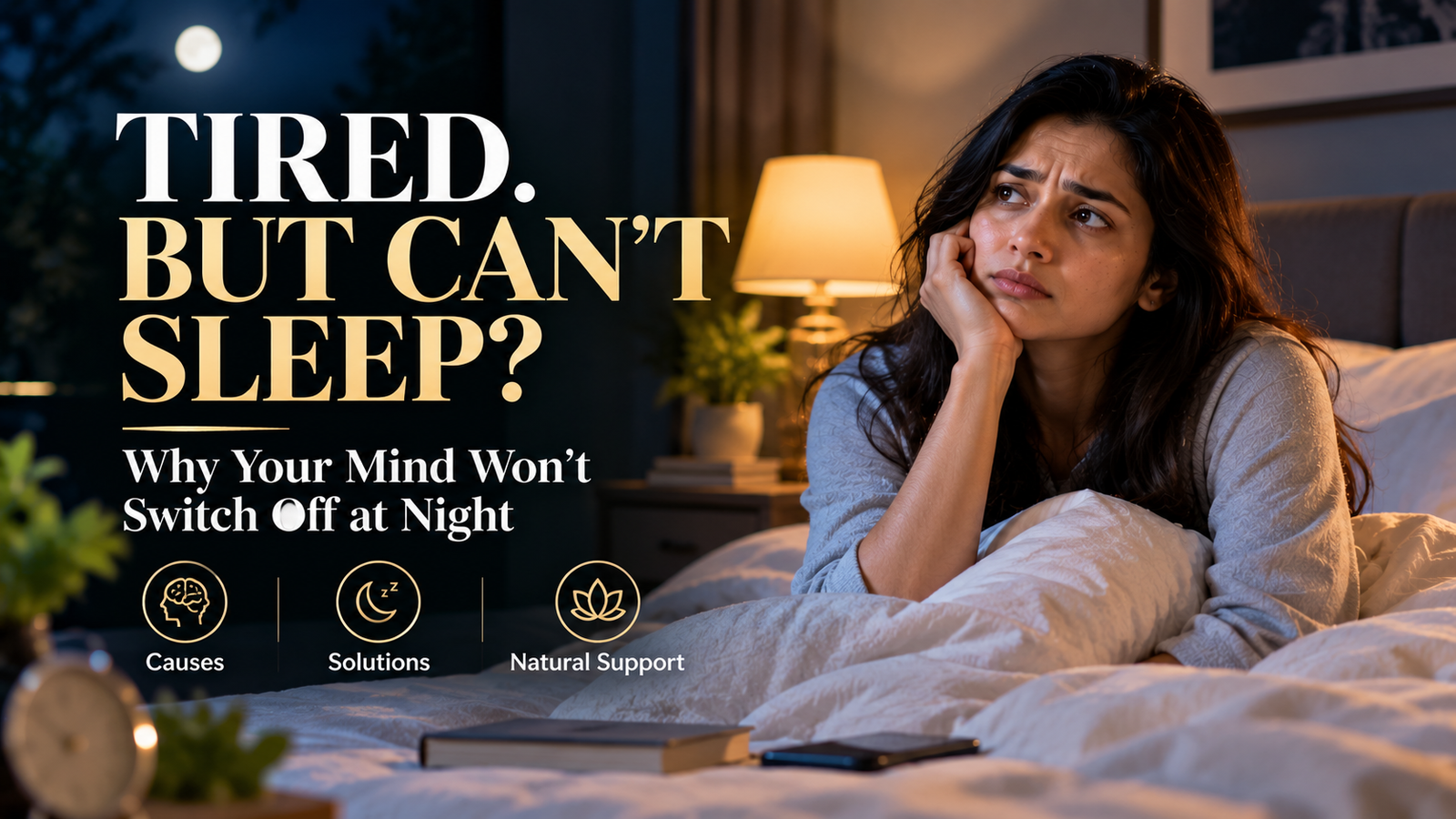
Why Can’t I Sleep Even When I’m Tired? 10 Causes & What Helps
You’re exhausted. Your body wants to rest. But the moment you lie down, your mind becomes wide awake.
You check the time. It’s 11:45 PM.
You close your eyes, remember tomorrow’s responsibilities, think about unfinished work and suddenly realise another hour has passed.
Sound familiar?
Being physically tired but unable to sleep is a frustrating experience. Sometimes described as feeling tired but wired, it can happen when your need for rest and your body’s alertness signals are out of sync.
The good news is that understanding what keeps you awake can help you make better decisions about your sleep.
In this guide, we explore 10 possible causes, why overthinking becomes worse at night, what to do when you cannot sleep and what scientific research says about L-theanine and ashwagandha.
Exhausted, but your mind won’t switch off?
Being physically tired does not always mean your brain is ready for sleep. Stress, racing thoughts, caffeine and irregular sleep schedules may keep you awake.
Worries become more noticeable when the day gets quiet.
Irregular sleep timing may delay natural sleepiness.
Caffeine, light and evening stimulation may interfere.
You may feel tired but struggle to fall asleep because of stress, racing thoughts, irregular sleep schedules, late caffeine, screen exposure, sleep disorders or other medical and psychological factors.
Being tired is not exactly the same as being sleepy.
Physical exhaustion does not always mean your brain is ready to transition into sleep.
The best solution depends on what is keeping you awake.
10 Reasons You Feel Tired but Cannot Sleep
1. Stress Keeps Your Mind Alert
Stress can activate the body’s alertness systems.
When you feel worried or under pressure, relaxing at bedtime may become difficult.
This does not necessarily mean your cortisol level is abnormally high. Stress-related sleeplessness cannot be diagnosed from symptoms alone.
2. Overthinking and Racing Thoughts
During the day, work and responsibilities occupy your attention.
At night, distractions decrease, allowing unresolved concerns to become more noticeable.
You may find yourself thinking about conversations, deadlines, finances or future decisions.
Repeatedly worrying about not sleeping can make the problem worse.
3. An Irregular Sleep Schedule
Your internal body clock helps regulate sleep and wakefulness.
Going to bed and waking up at widely different times may make it harder to feel sleepy when you want to.
Shift work, late nights and inconsistent weekend schedules can contribute.
4. Caffeine Too Late in the Day
Caffeine promotes alertness.
Coffee, tea, energy drinks, certain pre-workouts and some medicines may contain caffeine.
Its effects can last for hours, although sensitivity varies.
If you struggle with sleep, review your afternoon and evening caffeine intake.
5. Too Much Screen Time Before Bed
Bright light from screens can interfere with signals involved in sleep timing.
However, light is not the only concern.
Emotionally stimulating videos, work emails and social media can also keep your mind engaged.
6. Long or Late Afternoon Naps
Napping can be useful in some circumstances.
But long or late naps may reduce the sleep pressure that helps you fall asleep at night.
The effect varies depending on your sleep needs and schedule.
7. Sleep Anxiety
Some people begin worrying about sleep itself.
Thoughts such as “I must fall asleep now” or “Tomorrow will be ruined” may increase alertness.
Over time, the bed can become associated with frustration rather than rest.
8. Sleep Apnoea or Other Sleep Disorders
Obstructive sleep apnoea can cause disrupted sleep.
Possible signs include loud snoring, witnessed breathing pauses and excessive daytime sleepiness.
Restless legs syndrome and circadian rhythm disorders can also affect sleep.
These conditions require appropriate assessment.
9. Medicines or Health Conditions
Certain medications can interfere with sleep.
Pain, reflux, thyroid disorders and some mental health conditions may also contribute.
Never stop a prescribed medicine without consulting your clinician.
10. An Uncomfortable Sleep Environment
Noise, light, uncomfortable bedding and an excessively warm room may interfere with sleep.
A quiet, dark and comfortable environment can support better rest.
Why Does My Mind Race at Night?
Nighttime overthinking is often linked to reduced distractions and increased attention to unresolved concerns.
Stressful thoughts may activate feelings of alertness, making sleep more difficult.
A practical approach is to schedule a short period earlier in the evening to write down concerns and possible next steps.
This does not eliminate every worry, but it can help separate problem-solving from bedtime.
Why Do I Overthink More at Night Than During the Day?
During the day, conversations, work and daily tasks compete for your attention.
At night, there may be fewer distractions.
This can make worries feel more prominent.
If overthinking becomes frequent, distressing or interferes with daily life, professional support may be helpful.
Why Do I Wake Up at 3 AM and Cannot Fall Back Asleep?
Waking during the night can occur for several reasons:
- Stress or anxiety
- Alcohol consumption
- Noise or temperature changes
- Sleep apnoea
- Nocturia
- Pain or reflux
- Changes in sleep patterns
Waking at exactly 3 AM is not a reliable sign of a particular hormone imbalance or organ problem.
If nighttime awakenings are persistent, investigate the broader pattern rather than focusing on the clock time.
How to Fall Asleep Faster Naturally
1. Maintain a Consistent Wake-Up Time
Try to wake up at approximately the same time each day.
Consistency helps reinforce your sleep-wake rhythm.
2. Get Morning Daylight
Exposure to natural daylight after waking can help support circadian timing.
3. Reduce Evening Stimulation
Create a predictable wind-down routine.
Choose quiet activities rather than demanding work or emotionally stimulating content.
4. Review Caffeine Timing
If you are sensitive to caffeine, avoid it later in the day.
5. Keep the Bedroom Comfortable
A dark, quiet and comfortably cool environment may help.
6. Avoid Forcing Sleep
If you remain awake and frustrated, consider leaving the bed briefly and doing a quiet activity in dim light until you feel sleepy.
Avoid clock-watching.
7. Stay Physically Active
Regular exercise supports general health and sleep.
Choose exercise timing that works for you.
8. Address Persistent Sleep Problems
If sleep difficulties continue, cognitive behavioural therapy for insomnia (CBT-I) is an evidence-based first-line treatment for chronic insomnia.
Does L-Theanine Help With Sleep?
L-theanine is an amino acid naturally found in tea.
It has been studied for its potential effects on relaxation, stress-related outcomes and sleep.
A 2025 systematic review and meta-analysis examined 19 studies involving 897 participants.
The researchers found improvements in certain self-reported sleep measures, including perceived sleep quality.
However, improvements were not consistent across all objective sleep measurements, and several studies combined L-theanine with other ingredients.
The evidence is promising but does not establish L-theanine as a proven treatment for insomnia.
Is Suntheanine the Same as L-Theanine?
Suntheanine is a branded form of L-theanine.
It should not automatically be assumed to deliver superior clinical results compared with every other L-theanine formulation.
Any product-specific superiority claim requires appropriate comparative evidence.
Does Ashwagandha Help With Sleep?
Ashwagandha is a botanical ingredient used in traditional Ayurvedic practices.
Some clinical studies suggest that certain ashwagandha extracts may provide modest improvements in sleep-related outcomes.
However, studies have used different extracts, doses and populations.
Results cannot automatically be applied to every ashwagandha product.
Ashwagandha is not an established replacement for evidence-based insomnia treatment.
What Is Shoden Ashwagandha?
Shoden is a branded ashwagandha extract that has been investigated in human research.
A clinical study examined a specific Shoden preparation in adults reporting sleep difficulties.
The study reported improvements in some sleep-related measures compared with placebo.
However, the findings apply to the studied preparation and conditions.
They do not prove that every product containing Shoden will produce identical results.
Shoden Ashwagandha vs Regular Ashwagandha
| Feature | Shoden Ashwagandha | Other Ashwagandha Extracts |
|---|---|---|
| Ingredient type | Branded botanical extract | Root, leaf or combined extracts |
| Standardisation | Product-specific | Varies by manufacturer |
| Clinical research | Certain preparations studied | Multiple preparations studied |
| Sleep benefits | Potential benefits in limited studies | Potential benefits in limited studies |
| Guaranteed effectiveness | No | No |
The most useful comparison involves verified extract identity, composition, safety and clinical evidence—not branding alone.
Can You Take Ashwagandha and L-Theanine Together?
Both ingredients have been investigated individually for stress- or sleep-related outcomes.
However, evidence for a specific Shoden plus Suntheanine combination cannot be assumed from studies of each ingredient separately.
The combination may not be suitable for everyone.
Ashwagandha can cause drowsiness and may interact with sedatives, thyroid medicines, diabetes medicines, blood-pressure medicines and certain other treatments.
Rare cases of liver injury have also been associated with ashwagandha products.
Ashwagandha should be avoided during pregnancy and breastfeeding and may be unsuitable for people with certain thyroid, autoimmune or liver conditions.
Consult a qualified healthcare professional before combining supplements, especially if you take medication.
Ashwagandha vs L-Theanine for Sleep: Which Is Better?
There is insufficient direct comparative clinical evidence to declare one universally better.
| Question | Ashwagandha | L-Theanine |
|---|---|---|
| Studied for sleep? | Yes | Yes |
| Studied for stress-related outcomes? | Yes | Yes |
| Evidence limitations? | Extract-specific, often small trials | Mixed formulations and study designs |
| Established insomnia treatment? | No | No |
| Safety considerations? | Important interactions and liver-related concerns | Individual safety and medication review still matter |
Choosing a supplement should not replace identifying the underlying cause of sleep problems.
Does Magnesium Help You Sleep?
Magnesium is an essential mineral involved in normal nerve and muscle function.
Research on magnesium supplementation specifically for insomnia is limited and mixed.
People with insufficient magnesium intake may benefit from addressing their nutritional needs, but magnesium supplements are not established cures for chronic insomnia.
Explore the ingredient information for NutraMarck Magnesium Bisglycinate Tablets.
Can Glycine Improve Sleep Quality?
Glycine is an amino acid involved in multiple biological processes.
A small number of human studies have investigated glycine supplementation and sleep-related outcomes.
Findings are preliminary and do not establish glycine as a treatment for insomnia.
Explore NutraMarck Glycine Powder for formulation and ingredient information.
How Many Hours of Sleep Do Adults Need?
Most adults generally need around 7–9 hours of sleep per night, although individual requirements vary.
Sleep quality and daytime functioning also matter.
Spending more time in bed does not necessarily improve sleep if you are frequently awake.
When Should You See a Doctor About Sleep Problems?
Consider medical evaluation if:
- Sleep difficulties persist or worsen.
- Poor sleep affects work, mood or daily functioning.
- You snore loudly or experience breathing pauses.
- You regularly experience restless legs or significant nighttime discomfort.
- You rely on alcohol or sedatives to fall asleep.
- You suspect medication or another medical condition is contributing.
Persistent insomnia deserves appropriate assessment rather than repeated experimentation with supplements.
Explore Sleep & Wellness Nutrition.
Understand ingredients, formulations and usage information before choosing a supplement.
These supplements are not established treatments for insomnia. Review precautions before use.
Frequently Asked Questions
1. Why can’t I sleep even when I’m exhausted?
Stress, irregular sleep timing, caffeine, racing thoughts or medical conditions can interfere with sleep despite physical tiredness.
2. Why does my brain become active at bedtime?
Fewer distractions and unresolved worries may make thoughts more noticeable at night.
3. How can I stop overthinking at night?
Try writing down concerns earlier in the evening, maintaining a calming routine and avoiding pressure to fall asleep immediately.
4. Why do I wake up at 3 AM every night?
Possible causes include stress, sleep disorders, alcohol, nocturia and environmental disturbances. The specific hour does not establish a diagnosis.
5. How can I fall asleep faster without medication?
Consistent sleep timing, appropriate light exposure, reducing evening stimulation and addressing underlying sleep problems may help.
6. Does L-theanine make you sleepy?
Some studies suggest benefits for perceived sleep quality, but effects vary and it is not an established insomnia medicine.
7. Is Suntheanine different from L-theanine?
Suntheanine is a branded L-theanine ingredient.
8. Does Shoden Ashwagandha improve sleep?
A specific Shoden preparation has been studied with encouraging findings, but results are not guaranteed.
9. Can Shoden and Suntheanine be taken together?
Combination-specific evidence is limited. Safety depends on the formulation, individual health and medications.
10. Does ashwagandha reduce cortisol?
Some clinical studies have reported changes in cortisol measurements, but these findings do not establish treatment for a cortisol disorder.
11. Does magnesium help with insomnia?
Evidence remains limited. Correcting inadequate magnesium intake is different from treating insomnia.
12. Is glycine good for sleep?
Small studies have explored possible benefits, but evidence is preliminary.
13. Is melatonin better than ashwagandha?
They are different substances with different research contexts. Neither should be assumed to treat every cause of sleeplessness.
14. What is the best treatment for chronic insomnia?
CBT-I is recommended as a first-line treatment for adults with chronic insomnia.
15. When should I worry about poor sleep?
Seek evaluation when sleep problems are persistent, affect daily functioning or occur with symptoms suggesting another sleep or medical disorder.
Final Thoughts
Feeling tired but unable to sleep does not necessarily mean something is wrong with your cortisol or that you need a sleep supplement.
Stress, overthinking, caffeine, sleep timing and medical conditions can all contribute.
Better sleep begins with understanding what is keeping you awake.
L-theanine and certain ashwagandha extracts have been studied for sleep-related outcomes, but evidence is not sufficient to treat them as guaranteed solutions.
Prioritise consistent habits, realistic expectations and appropriate medical guidance when sleep problems persist.
Scientific References
- NIH NCCIH — Ashwagandha: Usefulness and Safety
- NIH ODS — Ashwagandha for Stress, Anxiety and Sleep
- L-Theanine and Sleep — 2025 Systematic Review and Meta-Analysis
- L-Theanine Dietary Supplementation Trials — Systematic Review
- American College of Physicians — Chronic Insomnia Guideline
- Cleveland Clinic — Racing Thoughts at Night
Medical Disclaimer: This article is for educational purposes and is not a substitute for medical advice. Supplements are not established treatments for chronic insomnia or anxiety disorders. Consult a healthcare professional about persistent sleep problems, medications and supplement safety.





Add comment