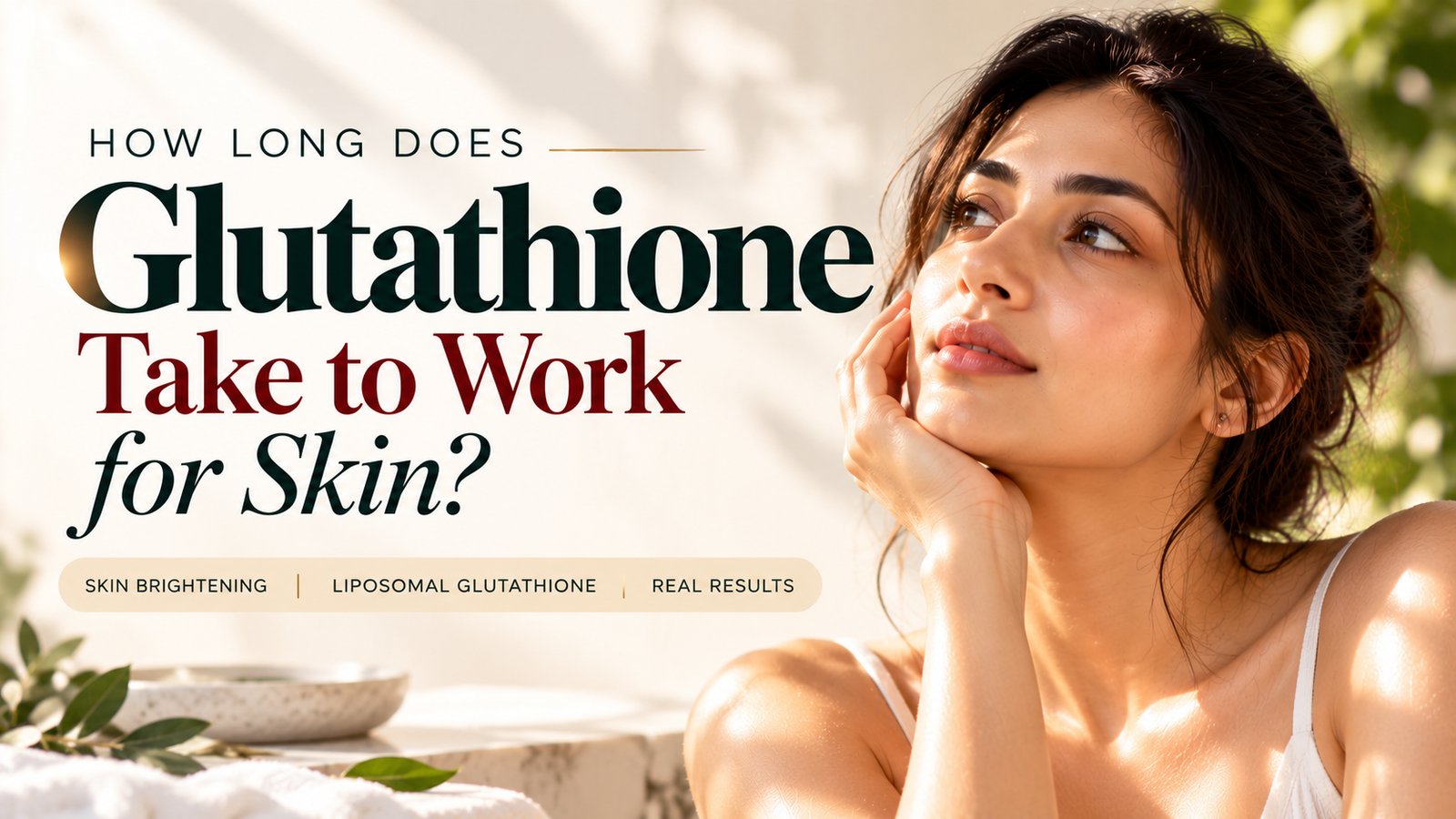
How Long Does Glutathione Take to Work for Skin? What Science Says
You have heard about glutathione for brighter-looking skin. But how long does it actually take to show results—two weeks, one month or three months?
This is one of the most common questions people ask before trying oral glutathione supplements.
Social media often features dramatic before-and-after photographs, claims of rapid skin whitening and promises of visible results within days.
But scientific evidence tells a more cautious story.
Glutathione is a naturally occurring antioxidant involved in several important processes in the human body. Researchers have also investigated whether oral glutathione supplementation can influence skin pigmentation.
The key finding: Some small clinical studies have reported changes in skin pigmentation after approximately 4–12 weeks of supplementation, but results are inconsistent and there is no scientifically established timeline that guarantees visible skin brightening.
This guide explains what the research shows, how liposomal glutathione differs from conventional formulations and what to consider before buying a supplement.
How soon can glutathione show skin results?
Some small clinical studies have investigated pigmentation changes after approximately 4–12 weeks of oral glutathione use. However, results are inconsistent and no visible outcome is guaranteed.
Some studies begin assessing pigmentation changes around this time.
Additional study observations, not guaranteed result milestones.
Durability and long-term cosmetic effectiveness remain uncertain.
Research timeframes are not predictions of individual results. Glutathione is not an established treatment for pigmentation disorders.
Quick Answer: How Long Does Glutathione Take to Work?
There is no guaranteed timeframe for visible skin changes from glutathione supplements.
A limited number of clinical studies have evaluated oral glutathione over periods ranging from several weeks to a few months.
Some reported modest changes in pigmentation measurements, while others found less clear or inconsistent results.
Importantly, these findings do not mean everyone will notice a change after four, eight or twelve weeks.
Results may depend on baseline pigmentation, sun exposure, study formulation, individual biology and how outcomes are measured.
Glutathione is not an established treatment for melasma, hyperpigmentation or skin whitening.
What Is Glutathione?
Glutathione is a small molecule made from three amino acids:
- Glutamate
- Cysteine
- Glycine
It is naturally produced by the body and found inside cells.
Glutathione plays important roles in antioxidant defence, maintaining cellular redox balance and supporting normal biological processes.
It is often called the body’s master antioxidant, although that is a popular descriptive phrase rather than a formal medical classification.
Why Is Glutathione Associated With Skin Health?
Researchers have investigated whether glutathione influences pathways involved in melanin production.
Melanin is the pigment responsible for much of the natural colour of skin, hair and eyes.
Laboratory research suggests glutathione may influence certain pigmentation-related processes.
However, laboratory mechanisms do not establish that taking a supplement will visibly lighten human skin.
Clinical trials are needed to determine whether a meaningful effect occurs.
Glutathione Skin Results: What Does the Research Show?
Several small clinical studies have investigated oral glutathione and skin pigmentation.
Some trials reported modest changes in melanin-related measurements after weeks of supplementation.
However, the studies differ in important ways:
- Participant numbers
- Glutathione formulation
- Supplement amounts
- Treatment duration
- Skin pigmentation assessment methods
- Baseline skin characteristics
Many studies are relatively small or short.
Because of these limitations, the evidence does not establish a reliable degree of skin brightening or a predictable time to results.
Glutathione Results Timeline: What Can You Realistically Expect?
| Time period | What the evidence supports |
|---|---|
| First 1–2 weeks | No reliable evidence of predictable visible skin brightening |
| Around 4 weeks | Some small studies have assessed pigmentation changes by this stage |
| Around 8 weeks | Some trials report modest changes in measured pigmentation |
| Around 12 weeks | Certain studies have evaluated outcomes over this duration |
| Beyond 12 weeks | Long-term effectiveness and durability remain uncertain |
Important: This is a summary of study observation periods, not a promise that glutathione will work within those timeframes.
Does Glutathione Really Brighten Skin?
Some studies suggest oral glutathione may modestly influence certain skin pigmentation measurements.
However, evidence is not strong enough to guarantee visible skin brightening for everyone.
There are also important differences between:
- A small change in a research instrument’s melanin measurement
- A noticeable improvement in uneven pigmentation
- A major change in natural skin colour
These outcomes should not be treated as equivalent.
Claims that glutathione permanently whitens skin or changes skin tone by several shades are not supported by robust clinical evidence.
Can Glutathione Reduce Dark Spots and Pigmentation?
Dark spots and uneven pigmentation can develop for many reasons.
Common examples include:
Sun-Induced Pigmentation
Ultraviolet exposure can stimulate melanin production and contribute to dark spots.
Post-Inflammatory Hyperpigmentation
Marks may remain after acne, irritation or other inflammatory skin conditions.
Melasma
Melasma involves complex interactions among sun exposure, hormones and other factors.
Age-Related Pigmentation
Some pigmentation changes become more noticeable with accumulated sun exposure and ageing.
Glutathione has been investigated for pigmentation-related outcomes, but it is not an established treatment for these conditions.
If dark spots are persistent, spreading or changing unexpectedly, a dermatologist can help identify the cause.
Liposomal Glutathione vs Regular Glutathione: Does Absorption Matter?
Liposomal formulations use lipid-based structures designed to carry ingredients.
The goal is to influence how an ingredient behaves during digestion and absorption.
However, not every product described as liposomal has identical properties.
Formulation quality, particle characteristics, manufacturing methods and testing may vary.
Is Liposomal Glutathione Better Absorbed?
Small human studies have explored the effects of liposomal glutathione supplementation on glutathione-related biological measurements.
Some findings suggest that certain formulations may influence glutathione status.
But these results cannot automatically be applied to every liposomal product.
More importantly, improved absorption does not necessarily mean proven superior skin-brightening results.
There is insufficient robust head-to-head clinical evidence demonstrating that liposomal glutathione consistently produces greater visible skin brightening than conventional oral glutathione.
Liposomal vs Regular Glutathione Comparison
| Feature | Regular oral glutathione | Liposomal glutathione |
|---|---|---|
| Formulation | Conventional oral delivery | Lipid-based delivery approach |
| Research | Some small human trials | Limited formulation-specific studies |
| Absorption | Depends on formulation and individual factors | May differ by formulation |
| Proven superior skin results | Not established | Not established |
| Guaranteed pigmentation improvement | No | No |
| Long-term skin-specific evidence | Limited | Limited |
Readers researching formulation differences can explore NutraMarck Liposomal Glutathione Capsules and review the complete ingredient declaration.
How Much Glutathione Is Used in Skin Studies?
Clinical studies have investigated different oral glutathione amounts and supplementation schedules.
Some skin-related studies have used daily amounts in the hundreds of milligrams.
However, the amounts used in research should not be interpreted as a universally recommended dose for skin brightening.
There is no widely established, evidence-based oral glutathione dose that reliably produces visible cosmetic results.
Does a Higher Dose Work Faster?
There is insufficient evidence to conclude that increasing the dose produces faster or better skin-brightening results.
Higher intake may also increase the possibility of unwanted effects.
Follow product directions and seek professional guidance where appropriate.
What Is the Best Time to Take Glutathione?
There is no convincing clinical evidence that taking glutathione in the morning, at night or on an empty stomach consistently produces better skin results.
Instructions may vary depending on the formulation.
If using a supplement, follow the label directions rather than assuming a particular time guarantees better absorption or cosmetic effects.
Should You Take Glutathione With Vitamin C?
Vitamin C contributes to normal antioxidant defence and collagen formation.
It also participates in biological processes related to maintaining antioxidant systems.
However, claims that combining vitamin C with glutathione guarantees faster skin whitening are not established by strong clinical evidence.
If a formulation contains multiple ingredients, each should be evaluated for its role, amount, safety and evidence.
Can Glutathione Make Skin Permanently Fair?
No high-quality evidence establishes that oral glutathione permanently changes natural skin colour.
Even where studies report pigmentation changes, long-term durability after stopping supplementation remains uncertain.
Natural skin pigmentation is influenced by genetics, hormones, environmental exposure and other factors.
Healthy skin does not need to become lighter to be considered healthy.
Does Glutathione Help With Acne Marks?
Post-inflammatory hyperpigmentation can occur after acne.
The strongest management approach depends on the type of acne, skin tone, severity and individual tolerance.
Evidence is insufficient to recommend oral glutathione as a reliable treatment for acne marks.
Dermatologists may recommend appropriate topical treatments, acne management and sun protection.
What Actually Helps With Uneven Skin Tone?
If your goal is to improve the appearance of uneven pigmentation, focus on measures supported by dermatological guidance.
1. Daily Sun Protection
Broad-spectrum sunscreen can help reduce ultraviolet-related pigmentation changes.
Choose a suitable sunscreen with SPF 30 or higher and use it according to the label.
For some pigmentation conditions, especially melasma, tinted sunscreen containing iron oxides may be useful because visible light can contribute to pigmentation.
2. Identify the Cause
Melasma, acne marks and sun spots may require different approaches.
3. Use Appropriate Skincare
A dermatologist may recommend ingredients such as azelaic acid or other treatments based on the diagnosis.
4. Avoid Aggressive Skin-Lightening Products
Unregulated products can contain harmful ingredients or inappropriate concentrations of active substances.
5. Maintain Realistic Expectations
Pigmentation improvement often takes time, and recurrence can occur.
Does Glutathione Work for Every Skin Type?
There is not enough evidence to predict which individuals will respond to oral glutathione.
Skin pigmentation varies across populations, and results from small studies cannot automatically be generalised to every skin tone.
A formulation’s effects may also vary between individuals.
Avoid relying on influencer photographs or edited before-and-after images as proof of effectiveness.
Oral Glutathione vs IV Glutathione: Which Is Safer?
Oral supplements and intravenous administration are very different.
IV glutathione bypasses the digestive system and introduces the substance directly into the bloodstream.
IV glutathione is sometimes promoted for skin whitening, but there are serious concerns about insufficient evidence and potential risks associated with such use.
IV glutathione should not be considered a routine or established cosmetic skin-whitening treatment.
Do not undergo unapproved injectable skin-whitening procedures based on advertising claims.
Discuss medical concerns with a qualified healthcare professional.
Are Glutathione Supplements Safe?
Oral glutathione has been studied in limited clinical settings, and some trials report relatively few short-term adverse effects.
However, long-term safety data for cosmetic use are limited.
Possible issues include gastrointestinal discomfort or reactions to other formulation ingredients.
People who are pregnant or breastfeeding, have significant medical conditions or take prescription medicines should seek professional advice before supplementation.
Safety also depends on product quality and the complete ingredient list.
How to Choose a Glutathione Supplement
Before purchasing, consider the following:
- Clearly identified glutathione form
- Transparent ingredient information
- Serving instructions
- Manufacturing and quality information
- Appropriate labelling
- Realistic, evidence-based claims
Understand the Formulation.
A considered supplement choice begins with ingredients, transparency and realistic expectations.
NutraMarck Liposomal Glutathione
Explore the liposomal formulation, complete ingredient information and suggested usage directions.
Explore Liposomal Glutathione →This dietary supplement is not an established treatment for melasma, dark spots or skin whitening.
For customers comparing oral glutathione formulations, NutraMarck Liposomal Glutathione Capsules provide a product page where you can review ingredients, serving directions and formulation information.
The presence of a liposomal delivery system does not establish guaranteed absorption superiority or skin-lightening results.
Glutathione Before and After: Can You Trust Online Photos?
Before-and-after images can be misleading because of differences in:
- Lighting
- Camera exposure
- Skin hydration
- Makeup
- Filters
- Image editing
- Sun exposure
A photograph alone cannot establish that a supplement caused a change in skin pigmentation.
Reliable research uses defined measurements, appropriate comparison groups and transparent methods.
Frequently Asked Questions
How long does glutathione take to work?
Small studies have examined skin pigmentation over roughly 4–12 weeks, but no reliable timeframe or result is guaranteed.
Does glutathione brighten skin in one month?
Some trials assessed pigmentation at four weeks, but visible brightening is not predictable for everyone.
Is liposomal glutathione better?
Some formulations have been studied for absorption, but superior skin results have not been established.
Can glutathione remove dark spots?
There is insufficient evidence to recommend oral glutathione as an established treatment for dark spots.
Does glutathione permanently whiten skin?
No reliable evidence demonstrates permanent skin whitening.
Can I take glutathione every day?
Daily regimens have been studied, but suitability depends on individual health, formulation and professional guidance.
When should I take glutathione?
No time of day is proven to produce better skin results. Follow product directions.
Does vitamin C make it work faster?
There is insufficient evidence that combining vitamin C with glutathione guarantees faster brightening.
Can glutathione help with melasma?
It is not an established melasma treatment. Consult a dermatologist for appropriate care.
Is long-term glutathione use safe?
Long-term safety data for cosmetic supplementation remain limited.
Does a higher dose work faster?
A reliable relationship between higher doses and faster skin results has not been established.
Is IV glutathione better for skin whitening?
IV glutathione is not an established cosmetic skin-whitening treatment and carries important safety concerns.
Final Verdict: How Long Does Glutathione Take to Work?
Glutathione is an important antioxidant naturally present in the body.
Small clinical studies have investigated its possible influence on skin pigmentation, sometimes over periods of four to twelve weeks.
However, the evidence remains limited, and no scientifically established timeline guarantees noticeable skin brightening.
Liposomal delivery is an interesting formulation approach, but it does not automatically translate into proven superior cosmetic results.
If your goal is healthier-looking, more even-toned skin, sun protection, identifying the cause of pigmentation and appropriate dermatological care should remain priorities.
When choosing a supplement, value transparent ingredients and realistic claims over promises of instant transformation.
Scientific References and Further Reading
- PubMed — Oral Glutathione and Skin Pigmentation Clinical Research
- PubMed — Liposomal Glutathione Human Research
- NIH PubMed — Glutathione and Skin Lightening Reviews
- American Academy of Dermatology — Melasma
- American Academy of Dermatology — Sunscreen Guidance
Medical Disclaimer: This article is for educational purposes only and is not a substitute for professional medical advice. Oral glutathione is not an established treatment for skin pigmentation disorders. Consult a qualified healthcare professional before using supplements, especially if pregnant, breastfeeding, taking medicines or managing a medical condition.






Add comment