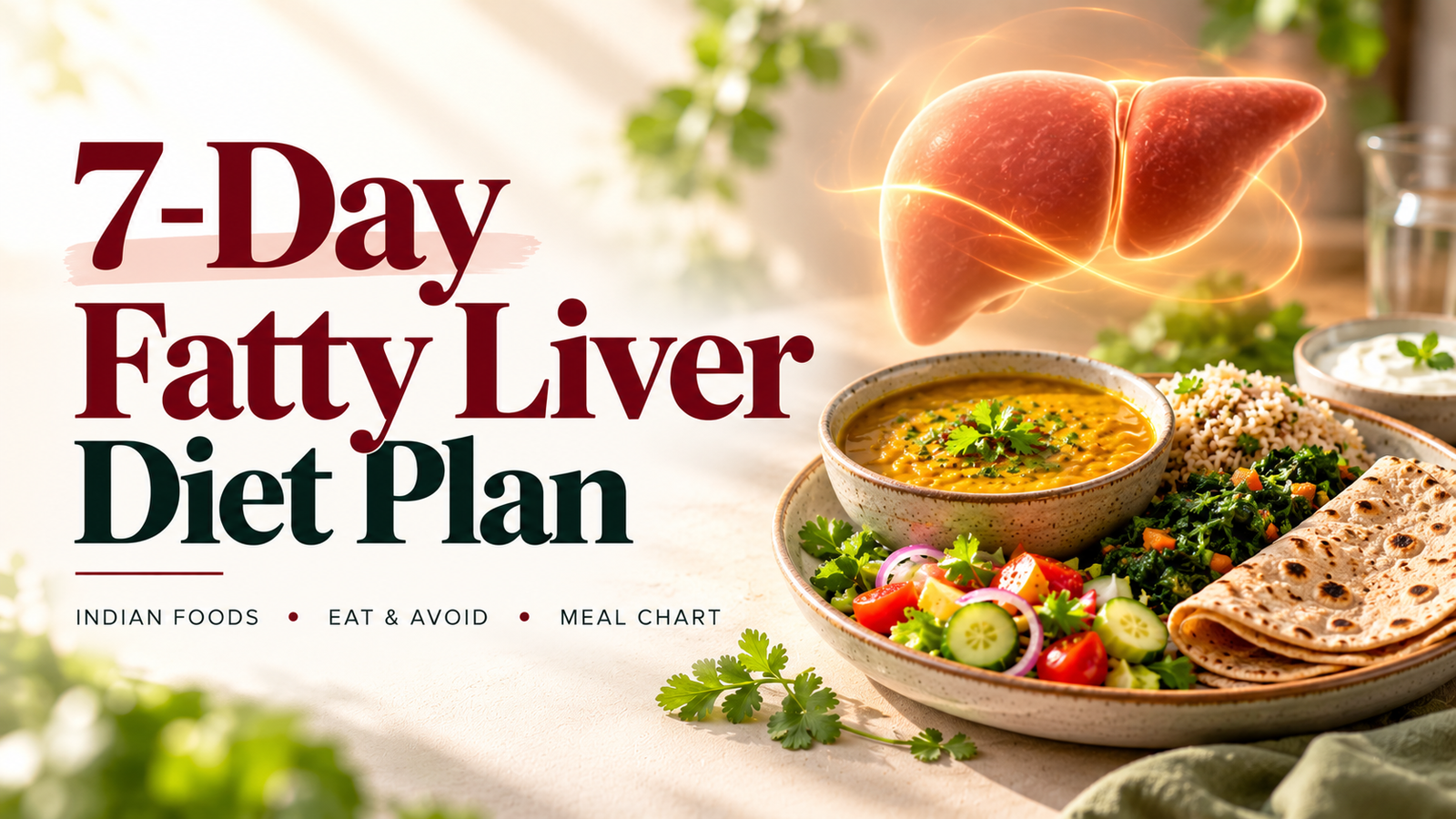
7-Day Indian Diet Plan for Fatty Liver: Foods to Eat, Avoid & Practical Meal Chart
Your ultrasound report says “fatty liver.” Now what should you actually eat?
Should you stop eating rice? Is roti better? Can you eat bananas? Is ghee harmful? And do you need a special liver detox diet?
These are common questions after a fatty liver diagnosis.
The good news is that improving your everyday eating habits can make a meaningful difference to liver health.
But you do not need an expensive detox programme, a juice-only diet or a cupboard full of supplements.
For many people with metabolic dysfunction-associated steatotic liver disease (MASLD), a balanced eating pattern, regular physical activity and sustainable weight management are central parts of care.
MASLD is the newer name for the condition previously called non-alcoholic fatty liver disease (NAFLD).
This guide provides a practical 7-day Indian diet plan, foods to prioritise, foods to limit, portion guidance and answers to common questions.
The meal plan is an educational example, not a personalised prescription. People with advanced liver disease, diabetes, kidney disease or other medical conditions may need a different approach.
What Is Fatty Liver Disease?
Fatty liver, medically called hepatic steatosis, means excess fat has accumulated in the liver.
It may occur for several reasons, including metabolic risk factors, alcohol consumption, certain medications and other medical conditions.
MASLD refers to steatotic liver disease associated with cardiometabolic risk factors.
Some people have fat accumulation without significant liver inflammation, while others may develop a more serious condition called metabolic dysfunction-associated steatohepatitis (MASH).
Over time, ongoing liver injury can lead to fibrosis, or scarring, in some individuals.
Not everyone with fatty liver develops advanced liver disease.
However, identifying the cause and assessing the risk of fibrosis are important.
Can Diet Help Improve Fatty Liver?
Yes.
Dietary changes can improve metabolic health and, in some people, reduce liver fat.
For individuals with overweight or obesity, sustained weight loss can be particularly beneficial.
Clinical guidance commonly associates:
- Approximately 3–5% weight loss with improvements in liver steatosis.
- Around 7–10% or greater weight loss with broader improvements in liver inflammation and, in some patients, fibrosis-related outcomes.
These are general clinical targets, not guarantees.
People who are already at a healthy weight may also have fatty liver and should not automatically follow a weight-loss diet.
The most suitable approach depends on the cause, nutritional status and severity of liver disease.
What Is the Best Indian Diet for Fatty Liver?
There is no single universally best diet.
Evidence supports eating patterns that emphasise vegetables, whole fruits, legumes, whole grains, unsaturated fats and appropriate protein sources while limiting sugar-sweetened beverages, excess refined carbohydrates and foods high in saturated fat.
A Mediterranean-style eating pattern is frequently recommended in clinical guidance.
It can be adapted to familiar Indian foods.
For example:
- Dal instead of processed meat
- Seasonal vegetables instead of heavily fried sides
- Whole fruit instead of packaged juice
- Whole-wheat roti instead of oversized portions of refined-flour foods
- Nuts and seeds in moderate portions
- Unsweetened curd instead of sugary desserts
You do not need to eliminate every carbohydrate or avoid all dietary fat.
7-Day Indian Diet Plan for Fatty Liver
This sample plan focuses on vegetarian Indian meals.
It is intended for generally healthy adults with uncomplicated fatty liver who do not require a medically prescribed diet.
Portion guide used in this plan:
- Roti: 1 medium whole-wheat roti
- Dal or beans: approximately ¾–1 cup cooked
- Rice: approximately ½–¾ cup cooked
- Curd: approximately 150–200 g plain, unsweetened
- Vegetables: approximately 1–2 cups per main meal
- Nuts: a small handful, around 15–20 g
Adjust quantities to individual calorie needs, body size, activity level and medical advice.
Day 1 — Start With Balanced Meals
| Meal | Indian vegetarian option |
|---|---|
| Breakfast | 2 vegetable besan chillas with plain curd |
| Mid-morning | 1 small apple |
| Lunch | 2 whole-wheat rotis, moong dal, mixed vegetables and salad |
| Evening | Unsweetened tea and a small portion of roasted chana |
| Dinner | Vegetable khichdi with curd and cucumber salad |
Daily focus: Replace sweetened drinks and refined-flour snacks with balanced meals.
Day 2 — Increase Fibre
| Meal | Indian vegetarian option |
|---|---|
| Breakfast | Vegetable oats upma with plain curd |
| Mid-morning | 1 orange |
| Lunch | Rajma, a moderate serving of brown or white rice and salad |
| Evening | A small handful of almonds |
| Dinner | 2 rotis, lauki sabzi and dal |
Daily focus: Include legumes, vegetables and whole grains.
Day 3 — Build a Protein-Rich Plate
| Meal | Indian vegetarian option |
|---|---|
| Breakfast | Moong dal chilla with mint chutney |
| Mid-morning | Guava |
| Lunch | 2 rotis, chana dal, bhindi and salad |
| Evening | Plain buttermilk without added sugar |
| Dinner | Tofu or moderate-fat paneer bhurji with vegetables and 1–2 rotis |
Daily focus: Include a meaningful protein source at each main meal.
Day 4 — Reduce Added Sugar
| Meal | Indian vegetarian option |
|---|---|
| Breakfast | Vegetable poha with peanuts and plain curd |
| Mid-morning | Papaya |
| Lunch | 2 rotis, mixed dal, cauliflower sabzi and salad |
| Evening | Roasted chana |
| Dinner | Vegetable daliya with a bowl of plain curd |
Daily focus: Avoid sugar-sweetened beverages and frequent sweet snacks.
Day 5 — Choose Healthier Fats
| Meal | Indian vegetarian option |
|---|---|
| Breakfast | Oats prepared with unsweetened milk, seeds and fruit |
| Mid-morning | 1 pear |
| Lunch | Chickpea curry, 2 rotis and mixed vegetables |
| Evening | A small handful of walnuts |
| Dinner | Tofu and vegetable stir-fry with a moderate serving of rice |
Daily focus: Prefer unsaturated fats in sensible portions.
Day 6 — Keep Portions Practical
| Meal | Indian vegetarian option |
|---|---|
| Breakfast | 2 idlis with sambar |
| Mid-morning | 1 seasonal whole fruit |
| Lunch | 2 rotis, dal, beans sabzi and salad |
| Evening | Plain curd with a small amount of seeds |
| Dinner | Vegetable and lentil soup, tofu and 1–2 rotis |
Daily focus: Avoid oversized portions while eating enough to meet nutritional needs.
Day 7 — Make It Sustainable
| Meal | Indian vegetarian option |
|---|---|
| Breakfast | Vegetable besan chilla with curd |
| Mid-morning | Guava or orange |
| Lunch | Chole, 2 rotis and cucumber salad |
| Evening | Roasted makhana with minimal added oil, plus unsweetened milk |
| Dinner | Moong dal khichdi with vegetables and plain curd |
Daily focus: Choose meals you can realistically repeat beyond seven days.
7-Day Fatty Liver Diet Chart at a Glance
| Day | Breakfast | Lunch | Dinner |
|---|---|---|---|
| 1 | Besan chilla | Roti + moong dal | Vegetable khichdi |
| 2 | Oats upma | Rajma + rice | Roti + lauki + dal |
| 3 | Moong chilla | Roti + chana dal | Tofu/paneer bhurji |
| 4 | Vegetable poha | Roti + mixed dal | Vegetable daliya |
| 5 | Oats + milk | Chickpea curry + roti | Tofu + vegetables |
| 6 | Idli + sambar | Roti + dal + beans | Lentil soup + tofu |
| 7 | Besan chilla | Chole + roti | Moong dal khichdi |
Remember: A seven-day plan is a starting point for building sustainable habits. It is not a seven-day treatment or cure for fatty liver.
Foods to Eat More Often With Fatty Liver
1. Non-Starchy Vegetables
Vegetables contribute fibre, vitamins, minerals and other beneficial compounds.
Examples include:
- Spinach
- Bottle gourd
- Bitter gourd
- Cauliflower
- Cabbage
- Okra
- Carrots
- Beans
- Cucumber
Aim for variety rather than relying on one vegetable.
2. Whole Fruits
Whole fruits can be part of a fatty liver-friendly eating pattern.
Good everyday options include apples, guava, oranges, berries, papaya and pears.
Fruit does not need to be eliminated simply because it contains naturally occurring sugars.
Portions may need adjustment for people managing diabetes.
3. Legumes and Pulses
Dal, rajma, chole, moong and other legumes provide protein and fibre.
They can help create satisfying meals.
4. Whole Grains
Whole-wheat roti, oats, daliya and other whole grains can support a balanced diet.
White rice can also fit in appropriate portions.
Overall dietary quality and total energy intake matter more than declaring one grain completely forbidden.
5. Protein-Rich Foods
Adequate protein supports normal body functions and helps maintain muscle.
Vegetarian choices include:
- Dal
- Chickpeas
- Tofu
- Plain curd
- Milk
- Paneer in suitable portions
- Soy foods
6. Unsaturated Fats
Nuts, seeds and appropriate cooking oils can contribute beneficial unsaturated fats.
However, oils and nuts are energy-dense, so portions still matter.
Foods to Limit With Fatty Liver
| Food or drink | Why moderation matters |
|---|---|
| Sugary soft drinks | Concentrated added sugar and calories |
| Packaged fruit juice | Less fibre than whole fruit; easy to overconsume |
| Frequent sweets | Added sugar and excess energy |
| Deep-fried snacks | Often energy-dense |
| Processed baked foods | May contain refined flour, sugar and saturated fat |
| Large portions of refined carbohydrates | Can contribute to excess energy intake |
| Foods high in saturated fat | May worsen overall cardiometabolic dietary quality |
| Alcohol | Can contribute to liver injury |
You do not need to categorise every food as completely good or bad.
Focus on frequency, portion size and the overall eating pattern.
Is Rice Bad for Fatty Liver?
No. Rice is not automatically harmful.
The amount eaten, the rest of the meal and total daily dietary intake matter.
A moderate portion of rice combined with dal, vegetables and an appropriate protein source can fit into a balanced eating plan.
Brown rice contains more fibre than typical polished white rice, but it is not a cure for fatty liver.
People with diabetes may need to pay particular attention to carbohydrate portions.
Roti vs Rice: Which Is Better for Fatty Liver?
Neither food is universally superior.
| Feature | Whole-Wheat Roti | Cooked Rice |
|---|---|---|
| Main nutrient | Carbohydrate | Carbohydrate |
| Fibre | Usually higher than polished white rice | Depends on rice variety |
| Protein | Some | Some |
| Portion control | Count rotis and size | Measure cooked portion |
| Suitable for fatty liver? | Yes | Yes |
Choose the option that works for your dietary preferences and portion needs.
Is Ghee Good or Bad for Fatty Liver?
Ghee contains a substantial amount of saturated fat.
It does not need to be described as a poison, but adding large amounts is not advisable.
For people with fatty liver and metabolic risk factors, replacing some saturated fat with unsaturated fat sources may be beneficial.
Use cooking fats in moderate amounts.
Can You Eat Bananas With Fatty Liver?
Yes, bananas can be part of a balanced diet.
They provide carbohydrates, fibre and micronutrients.
They do not directly cause fatty liver when consumed as part of an appropriate eating pattern.
People with diabetes may need individual carbohydrate guidance.
Is Coffee Good for Fatty Liver?
Observational research has linked coffee consumption with certain favourable liver outcomes.
Some clinical guidelines recognise potential liver-health benefits associated with coffee.
However, these findings do not mean coffee is a treatment or that everyone should start drinking it.
Avoid turning coffee into a high-sugar beverage.
People with sleep problems, pregnancy-related restrictions, heart rhythm concerns or caffeine sensitivity may need to limit caffeine.
Does Lemon Water Remove Fat From the Liver?
No reliable clinical evidence shows that lemon water directly removes liver fat.
Water with lemon can be a refreshing alternative to sugary drinks.
Its main value may be helping someone choose a lower-sugar beverage.
It is not a liver detox treatment.
Can Intermittent Fasting Help Fatty Liver?
Some people may find time-restricted eating helpful for managing total energy intake.
However, it is not necessary for everyone.
Research has not established that intermittent fasting is consistently superior to other sustainable dietary approaches when energy intake and weight loss are comparable.
Fasting can also be unsuitable for certain people, including those taking medications that can cause low blood glucose.
Consult a healthcare professional before making major changes.
How Much Weight Loss Can Help Fatty Liver?
For people with excess body weight, gradual and sustained weight reduction can improve liver fat and metabolic health.
Consider an illustrative example.
A person weighing 80 kg who loses:
- 3% of body weight loses approximately 2.4 kg.
- 5% loses approximately 4 kg.
- 7% loses approximately 5.6 kg.
- 10% loses approximately 8 kg.
These figures illustrate percentages; they are not individual treatment targets.
People who are underweight or already at a healthy weight should not pursue weight loss without appropriate clinical advice.
Crash dieting and extreme restriction are not recommended.
Exercise for Fatty Liver: What Helps?
Physical activity can improve cardiometabolic health and may reduce liver fat, even without substantial weight loss.
A practical goal for many adults is at least 150 minutes of moderate-intensity physical activity per week, alongside suitable muscle-strengthening activity.
Examples include:
- Brisk walking
- Cycling
- Swimming
- Resistance training
- Active daily routines
Start at an appropriate level.
People with advanced liver disease, cardiovascular conditions or significant physical limitations should seek personalised advice.
Can Fatty Liver Improve Without Supplements?
Yes.
Many people can improve liver fat and metabolic risk factors through sustainable dietary and lifestyle changes.
However, the likelihood of improvement depends on the cause, disease severity and individual circumstances.
Lifestyle changes do not eliminate the need for medical evaluation.
People with significant fibrosis, MASH or other liver diseases may require additional treatment.
Do Liver Detox Supplements Work?
The phrase liver detox is frequently used in supplement marketing.
However, the liver already performs essential metabolic and detoxification functions.
There is no convincing evidence that a general over-the-counter detox supplement can reliably reverse fatty liver.
Some herbal and dietary supplements can even cause liver injury.
Do not use supplements as a substitute for appropriate medical care.
What About TUDCA for Liver Health?
Tauroursodeoxycholic acid, or TUDCA, is a bile acid derivative studied in several research settings.
However, TUDCA is not an established standard treatment for MASLD or MASH, and evidence does not support claiming that an over-the-counter TUDCA supplement reverses fatty liver.
Clinical management should focus on the underlying condition, metabolic risk factors and appropriate medical treatment.
For readers researching bile acid supplements, explore NutraMarck TUDCA Liver Support Capsules to review the formulation and product information.
The product should not be presented as a treatment for fatty liver disease.
What About People With Fatty Liver Who Are Not Overweight?
Fatty liver can occur in people with a normal body mass index.
This is sometimes called lean MASLD when the relevant diagnostic criteria are met.
A person who is not overweight may still have metabolic risk factors.
The appropriate plan may focus on dietary quality, physical activity, muscle health and management of associated conditions rather than significant weight loss.
Medical evaluation is important.
Fatty Liver Grade 1, 2 and 3: Does the Diet Change?
Ultrasound reports sometimes describe fatty liver as mild, moderate or severe.
These descriptions generally refer to imaging estimates of fat accumulation.
They do not reliably determine the amount of liver scarring.
A person with apparently mild steatosis can still have clinically important fibrosis.
Doctors may use blood tests, fibrosis risk scores such as FIB-4, elastography or other assessments when appropriate.
Dietary recommendations may be broadly similar, but treatment decisions depend on the complete clinical picture.
Can Fatty Liver Cause High ALT and AST?
Fatty liver may be associated with elevated liver enzymes.
However, ALT and AST can rise for many reasons.
Normal liver enzyme levels do not exclude significant liver disease.
If liver tests are abnormal, medical evaluation is necessary to determine the cause.
Common Mistakes in a Fatty Liver Diet
Mistake 1: Stopping All Carbohydrates
Carbohydrates do not need to be eliminated.
Portions and food quality are more important.
Mistake 2: Drinking Fruit Juice Instead of Eating Fruit
Whole fruit generally provides more fibre and may be more filling.
Mistake 3: Following Extreme Detox Diets
Detox diets are not established treatments for fatty liver.
Mistake 4: Ignoring Portion Sizes
Even nutritious foods can contribute excess calories when consumed in very large portions.
Mistake 5: Focusing Only on Supplements
Supplements cannot replace dietary changes, exercise and appropriate medical management.
Mistake 6: Assuming a Normal ALT Means the Liver Is Healthy
Normal liver enzymes do not rule out fibrosis.
Mistake 7: Ignoring Alcohol
Alcohol can contribute to liver damage. People with liver disease should discuss alcohol avoidance with their clinician; abstinence is especially important with advanced fibrosis or cirrhosis.
When Should You See a Doctor?
A fatty liver finding should be reviewed by a qualified healthcare professional.
Medical assessment is especially important if you have:
- Type 2 diabetes
- Obesity or other metabolic risk factors
- Persistently abnormal liver tests
- A history of significant alcohol consumption
- Other possible causes of liver disease
- Suspected liver fibrosis
Seek urgent care for symptoms such as vomiting blood, black stools, new confusion, severe abdominal swelling or jaundice accompanied by significant illness.
Frequently Asked Questions
What is the best Indian breakfast for fatty liver?
Balanced options include vegetable besan chilla, moong dal chilla, oats with unsweetened milk or idli with sambar.
Can I eat roti every day with fatty liver?
Yes. Whole-wheat roti can fit into a balanced eating pattern. Portions should reflect individual needs.
Can I eat rice with fatty liver?
Yes. Rice can be included in moderate portions alongside vegetables and protein-rich foods.
Is banana good for fatty liver?
Bananas can be part of a balanced diet. No single fruit cures or causes fatty liver on its own.
Is curd good for fatty liver?
Plain, unsweetened curd can provide protein and other nutrients. Choose portions and fat content appropriate for your needs.
Is paneer allowed in a fatty liver diet?
Yes, in suitable portions. Paneer varies in fat and calorie content, so preparation matters.
Can lemon water cure fatty liver?
No. Lemon water has not been proven to cure fatty liver.
Is black coffee good for fatty liver?
Coffee consumption has been associated with certain favourable liver outcomes, but it is not a replacement for medical treatment.
Can I reverse fatty liver in seven days?
A seven-day diet plan cannot guarantee reversal of fatty liver. Meaningful changes generally require sustained habits and appropriate medical management.
Does fatty liver mean I must stop eating sugar completely?
Reducing added sugars, especially sugary drinks, is advisable. Total dietary quality and energy balance remain important.
Is walking enough for fatty liver?
Walking can be beneficial, particularly when performed regularly. Strength training and other appropriate physical activity may provide additional benefits.
Do I need a liver detox supplement?
There is no established need for general liver detox supplements to treat fatty liver. Some supplements can cause liver injury.
Can a thin person have fatty liver?
Yes. Fatty liver can occur in people who are not overweight.
Can fatty liver progress even when liver enzymes are normal?
Yes. Normal ALT and AST levels do not reliably exclude significant fibrosis.
Final Thoughts
A fatty liver diagnosis does not mean you need to give up every food you enjoy.
For many people, meaningful improvements begin with practical everyday decisions:
- Eat more vegetables and fibre-rich foods.
- Include adequate protein.
- Reduce sugary drinks and frequent highly processed snacks.
- Choose sensible portions.
- Stay physically active.
- Follow appropriate medical advice.
The goal is not to follow a perfect diet for seven days.
The goal is to build an eating pattern you can maintain for years.
A balanced Indian diet can be a practical foundation for better metabolic and liver health.
Scientific References
- NIDDK — Treatment for NAFLD and NASH
- NIDDK — Eating, Diet & Nutrition for NAFLD and NASH
- AASLD — Practice Guidance on NAFLD
- EASL–EASD–EASO Clinical Practice Guidelines on MASLD
- World Health Organization — Physical Activity
Medical Disclaimer: This article provides general educational information and is not a substitute for medical advice. The sample meal plan is not suitable for everyone. People with cirrhosis, advanced liver disease, diabetes, kidney disease, pregnancy-related dietary requirements or other medical conditions should seek individualised guidance from a qualified healthcare professional or registered dietitian.





Add comment