
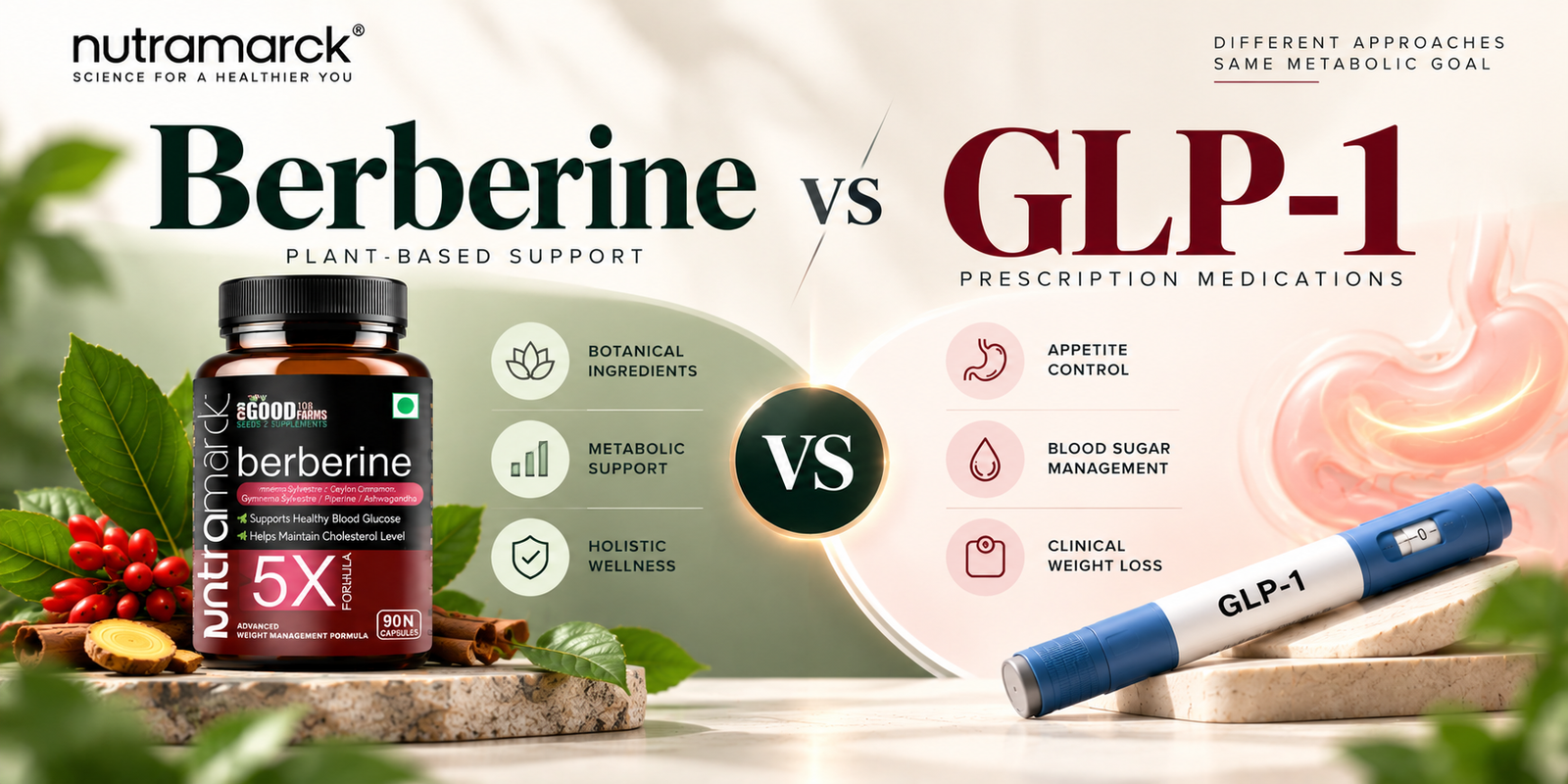
Berberine vs GLP-1: Which Is Better for Weight Loss & Blood Sugar?
Everyone is talking about GLP-1 injections. But can berberine, a plant-derived compound, offer similar benefits?
If you’ve been researching weight loss, insulin resistance or blood sugar management, you’ve probably encountered two increasingly popular terms: berberine and GLP-1.
Berberine is a botanical compound studied for its potential effects on glucose and lipid metabolism. GLP-1 is a hormone produced naturally in the gut, and certain prescription medications activate its receptors to help manage diabetes or obesity.
This has sparked an important question:
Is berberine a natural alternative to GLP-1 medications such as semaglutide?
The short answer is no. Although both are discussed in metabolic-health research, they work differently and have very different levels of clinical evidence.
In this guide, we’ll explore their benefits, weight-loss research, effects on blood sugar, safety and the differences that matter most.
What Is Berberine?
Berberine is a naturally occurring plant alkaloid found in several species, including plants from the Berberis family.
It has a long history of traditional use and has become a subject of modern metabolic research.
Scientists have investigated berberine in relation to:
- Blood glucose regulation
- Insulin sensitivity
- Lipid metabolism
- Cellular energy pathways
- Body-weight measurements
Some clinical studies have reported promising results for certain metabolic markers. However, many studies have limitations, and these findings do not establish berberine as a treatment for diabetes or obesity.
For readers researching botanical formulations, explore NutraMarck Berberine 5X Capsules.
What Is GLP-1?
GLP-1 stands for Glucagon-Like Peptide-1.
It is a hormone released by the intestine in response to food.
Natural GLP-1 helps regulate several processes, including insulin secretion, glucagon activity, gastric emptying and appetite.
Prescription GLP-1 receptor agonists are medicines that activate GLP-1 receptors for longer-lasting effects.
Examples include semaglutide and liraglutide.
Tirzepatide is a related medication that activates both GIP and GLP-1 receptors.
Different medicines have different approved indications, doses and safety requirements.
Berberine vs GLP-1: Key Differences
| Feature | Berberine | GLP-1-Based Prescription Medicines |
|---|---|---|
| What is it? | Plant-derived compound | Medicines that activate GLP-1 receptors |
| Main research area | Glucose and lipid metabolism | Diabetes and weight management |
| Weight-loss evidence | Limited and inconsistent | Strong evidence for certain approved medicines |
| Blood sugar effects | Possible improvements in some studies | Established glucose-lowering effects for approved treatments |
| Appetite effects | Not established as comparable to GLP-1 medicines | Clinically demonstrated for certain medicines |
| Availability | Dietary supplements | Prescription |
| Common side effects | Digestive discomfort | Digestive discomfort; additional serious risks |
| Can replace diabetes medication? | No | Used as prescribed for approved indications |
The biggest difference is not whether one is natural. It is how reliably each has been studied and what clinical benefits have been demonstrated.
1. Berberine vs GLP-1 for Weight Loss
Weight loss is one of the main reasons people compare berberine with GLP-1 medications.
How GLP-1 Medicines Affect Weight
Certain GLP-1 receptor agonists influence appetite and fullness signals.
This can help eligible patients reduce food intake and achieve clinically meaningful weight loss.
The results depend on the specific medicine, dose, duration and individual response.
What Research Says About Berberine
Berberine has been investigated for possible effects on body weight and metabolic markers.
Some small studies have reported changes in weight or body mass index.
However, research findings are inconsistent, and many studies have methodological limitations.
There is not enough rigorous evidence to establish berberine as an effective weight-loss treatment.
Verdict: Certain prescription GLP-1-based medicines have much stronger evidence for weight management. Berberine has not been shown to produce comparable results.
2. Berberine vs GLP-1 for Blood Sugar
Blood sugar management is another major area of interest.
GLP-1 and Blood Glucose
GLP-1 receptor agonists can stimulate insulin secretion when glucose levels are elevated.
Certain medications in this class are established treatments for type 2 diabetes.
Berberine and Blood Glucose
Some clinical studies have investigated berberine for its effects on fasting glucose, HbA1c and insulin-related measurements.
The US National Center for Complementary and Integrative Health notes that some findings suggest possible benefits, but the overall evidence has important limitations.
These studies do not establish berberine as a replacement for prescription diabetes treatment.
Verdict: GLP-1-based prescription medicines have established clinical uses. Berberine remains an investigational botanical compound for these outcomes.
3. Berberine vs GLP-1 for Insulin Resistance
Insulin resistance develops when cells respond less effectively to insulin.
It may be associated with prediabetes, type 2 diabetes, PCOS and other metabolic conditions.
Some GLP-1-based medicines improve glucose-related outcomes in appropriate patients.
Berberine has also been studied for possible effects on insulin sensitivity.
However, there is insufficient evidence to recommend berberine as a standard treatment for insulin resistance.
Regular physical activity, balanced nutrition and appropriate medical assessment remain important.
4. Does Berberine Work Like GLP-1?
Not in the same established clinical way.
GLP-1 receptor agonists are specifically designed to activate GLP-1 receptors.
Berberine has been investigated for multiple metabolic pathways, including pathways involved in cellular energy regulation.
Some laboratory and animal studies have explored connections between berberine and gut hormone signalling.
But those findings do not prove that taking berberine supplements produces clinically meaningful GLP-1-like effects in humans.
Berberine should not be described as a proven GLP-1 booster or receptor agonist.
5. Is Berberine Really “Nature’s Ozempic”?
You may have seen berberine described online as Nature’s Ozempic.
The phrase attracts attention, but it is misleading.
Ozempic is a prescription semaglutide product with established medical indications.
Berberine is a plant-derived compound sold in dietary supplements.
They differ in:
- Mechanism of action
- Clinical evidence
- Regulatory requirements
- Product consistency
- Dosing
- Safety monitoring
There is no reliable evidence that berberine delivers the same weight-loss outcomes as semaglutide.
Natural origin does not mean equivalent effectiveness or greater safety.
6. Can Berberine Reduce Appetite?
Research into berberine and appetite regulation is still developing.
Although certain experimental findings have generated interest, there is insufficient high-quality human evidence to conclude that berberine reliably suppresses appetite.
GLP-1-based medicines, by contrast, have established effects on appetite and fullness in appropriate clinical settings.
Do not expect a berberine supplement to reproduce those effects.
7. Berberine vs GLP-1 for PCOS
PCOS, or Polycystic Ovary Syndrome, can involve hormonal and metabolic changes.
Some women with PCOS also experience insulin resistance or weight-management difficulties.
GLP-1 receptor agonists have been studied in selected women with PCOS, particularly for weight-related outcomes.
Berberine has also been investigated, but the evidence remains limited.
Neither is a universal treatment for PCOS.
Women who are pregnant or planning pregnancy need particular caution, and treatment decisions should be made with a qualified clinician.
8. Side Effects: Berberine vs GLP-1
Both can cause unwanted effects.
Possible Berberine Side Effects
- Nausea
- Abdominal discomfort
- Diarrhoea
- Constipation
- Bloating
- Medication interactions
Berberine should generally be avoided during pregnancy and breastfeeding and should not be given to infants.
Possible GLP-1 Medication Side Effects
- Nausea
- Vomiting
- Diarrhoea
- Constipation
- Abdominal discomfort
Certain GLP-1-based medicines also carry warnings about serious risks, including pancreatitis, gallbladder problems and dehydration-related complications.
Contraindications and warnings differ by medication.
9. Can You Take Berberine With GLP-1 Injections?
Do not combine berberine with a prescription GLP-1-based medicine without discussing it with your healthcare professional.
Berberine can interact with medicines.
Adding supplements to an existing diabetes or weight-management treatment plan may create safety concerns or complicate glucose monitoring.
Your clinician should review all medications, supplements and medical conditions before recommending a combination.
10. Who Should Be Especially Careful With Berberine?
Professional advice is important for people who:
- Take prescription medication
- Have diabetes
- Have liver or kidney conditions
- Are pregnant or breastfeeding
- Are planning pregnancy
- Have complex medical conditions
The safety of a supplement depends on its ingredients, dose, formulation and the person taking it.
11. What About Berberine Dosage?
Different studies have used different doses and formulations.
That makes it difficult to translate research findings into one universally appropriate supplement dose.
Do not copy doses from clinical studies or social media recommendations.
Review the product label and discuss suitability with a healthcare professional, particularly if you take medication.
12. Choosing a Berberine Supplement: What Should You Check?
If you are researching berberine products, look beyond advertising claims.
Ingredient Transparency
Check whether the label identifies the ingredients and quantities clearly.
Serving Information
Understand the difference between the amount per capsule and the amount per recommended serving.
Additional Botanicals
Some products combine berberine with other ingredients.
These may introduce additional safety considerations.
Quality Information
Look for clear manufacturing and product-quality information.
Realistic Claims
Avoid supplements promising guaranteed fat loss, diabetes reversal or prescription-drug equivalence.
13. NutraMarck Berberine 5X: Understanding the Formula
NutraMarck Berberine 5X is a multi-ingredient botanical supplement.
Its labelled formulation includes:
- Berberine
- Ceylon cinnamon
- Gymnema sylvestre
- Ashwagandha
- Black pepper
These ingredients have different traditional uses and areas of scientific investigation.
However, the presence of several botanical ingredients does not prove that their combination produces superior clinical results.
NutraMarck Berberine 5X is not a GLP-1 medicine and should not be presented as a treatment for diabetes or obesity.
Explore NutraMarck Berberine 5X Capsules →
Review the complete product label, recommended serving and precautions before use.
14. Natural Ways to Support Metabolic Health
Whether you are researching berberine or discussing prescription weight-management treatment with your clinician, everyday habits remain important.
Eat More Fibre-Rich Foods
Include lentils, beans, vegetables, fruits and whole grains.
Prioritise Adequate Protein
Choose appropriate sources such as paneer, tofu, curd, eggs, dal, fish or lean poultry.
Stay Physically Active
Combine regular walking or other aerobic activity with resistance training.
Maintain Healthy Sleep Habits
Consistent, sufficient sleep supports general health and metabolic regulation.
Avoid Crash Dieting
Severely restrictive diets can be difficult to sustain and may create nutritional problems.
Monitor Relevant Health Markers
Discuss blood glucose, HbA1c, blood pressure and other tests with your healthcare professional when appropriate.
15. Indian Diet Plan for Metabolic Wellness
A balanced Indian eating pattern can support overall health without expensive specialty foods.
| Meal | Example |
|---|---|
| Breakfast | Moong dal chilla with curd |
| Mid-morning | Whole fruit and a few nuts |
| Lunch | Roti, dal, vegetables and salad |
| Evening | Roasted chana |
| Dinner | Paneer or tofu with vegetables and roti |
This is a general nutritional example, not a diabetes treatment plan or a diet proven to mimic GLP-1 medication.
Individual needs vary.
16. Which Is Better: Berberine or GLP-1?
The answer depends on what you mean by “better.”
For clinically established weight-loss treatment: Certain approved GLP-1-based medicines have much stronger evidence.
For medically managed type 2 diabetes: GLP-1 receptor agonists have established roles in appropriate patients.
For research into botanical metabolic compounds: Berberine is scientifically interesting, but clinical conclusions remain limited.
These are not equivalent alternatives.
The appropriate choice depends on individual medical needs, evidence, safety and professional guidance.
Frequently Asked Questions
Is berberine the same as GLP-1?
No. Berberine is a plant-derived compound, while GLP-1 is a naturally occurring hormone. Prescription GLP-1 receptor agonists are medicines designed to activate GLP-1 receptors.
Can berberine replace GLP-1 injections?
No. Berberine has not been established as an equivalent alternative to GLP-1-based prescription medicines.
Is berberine better than Ozempic?
There is no reliable evidence showing berberine is more effective than Ozempic for its approved medical uses.
Does berberine help with weight loss?
Some studies have investigated weight-related outcomes, but evidence remains insufficient to establish it as an effective weight-loss treatment.
Does berberine increase GLP-1 naturally?
Some experimental studies have explored possible effects on GLP-1 signalling. Clinically meaningful effects in humans have not been established.
Is berberine good for insulin resistance?
Berberine has been studied for insulin-related markers, but it is not an established treatment for insulin resistance.
Is berberine safer than GLP-1 medication?
Not necessarily. Both have potential adverse effects, and their risks differ. Natural does not automatically mean safer.
Can I take berberine with semaglutide?
Only after discussing the combination with your healthcare professional.
Can berberine help with PCOS?
Berberine has been studied in PCOS, but the evidence is limited and it is not a substitute for recommended care.
What is a natural alternative to GLP-1 injections?
No food or ordinary dietary supplement has been established as an equivalent alternative to prescription GLP-1-based treatment.
Does GLP-1 cause weight loss?
Certain prescription medicines that activate GLP-1 receptors can produce clinically meaningful weight loss in eligible patients.
Should I take berberine every day?
Supplement suitability and dosing depend on the product, individual health status and other medications. Consult a healthcare professional when appropriate.
Final Verdict: Understand the Difference Before Choosing
Berberine and GLP-1-based medicines are often discussed together because both appear in conversations about metabolic health.
But the similarities should not be exaggerated.
GLP-1-based prescription medicines have established clinical roles in diabetes and weight management. Berberine is a botanical compound with promising but limited research for certain metabolic outcomes.
A responsible approach starts with understanding the evidence, evaluating safety and avoiding exaggerated claims.
For readers interested in botanical metabolic-wellness ingredients, discover NutraMarck Berberine 5X Capsules and review their full formulation and precautions.
Scientific References
- NIH NCCIH — Berberine and Weight Loss: What You Need to Know
- NIH NCCIH — Diabetes and Dietary Supplements
- NIDDK — Prescription Medications to Treat Overweight and Obesity
- NIDDK — Weight-Loss Medications in Diabetes Care
- NIH NCCIH — Berberine Research and Safety
Medical Disclaimer: This article is for educational purposes only and is not intended to diagnose, treat, cure or prevent disease. Berberine supplements should not replace prescription diabetes or weight-management medicines. Consult a qualified healthcare professional before using supplements, especially if you take medication, have a medical condition, are pregnant or are breastfeeding.






Add comment