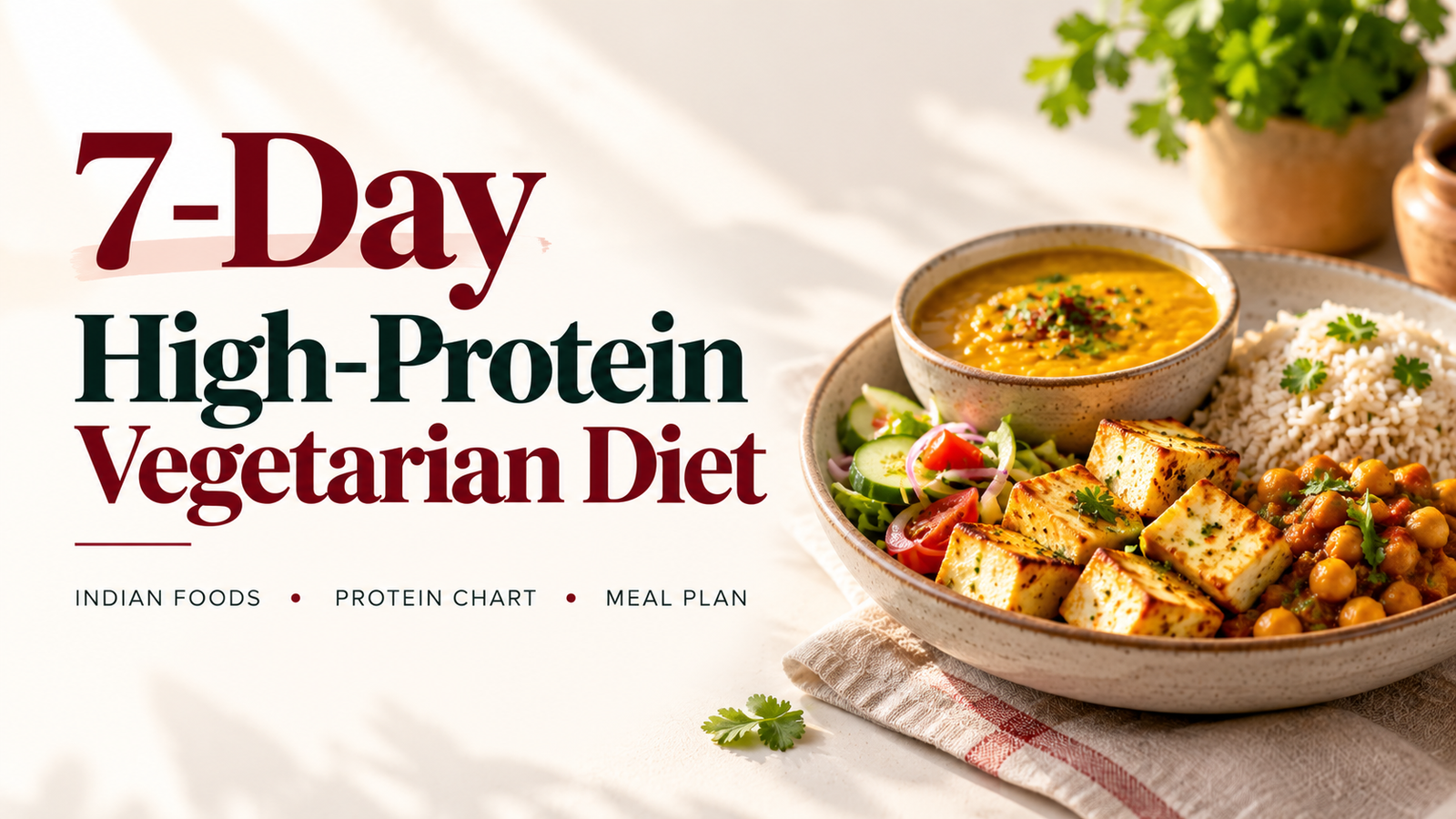
7-Day High-Protein Vegetarian Diet Plan: Indian Foods, Protein Chart & Meal Ideas
Think you need chicken, fish or eggs to get enough protein? Think again.
A well-planned Indian vegetarian diet can provide substantial protein using everyday foods such as dal, paneer, curd, tofu, soy chunks, chickpeas and whole grains.
The challenge is not necessarily finding protein-rich vegetarian foods.
It is knowing how much to eat, how to combine different foods and how to spread protein throughout the day.
If your breakfast consists of tea and biscuits, lunch is mostly rice and dinner contains only a small serving of dal, your protein intake may be lower than you realise.
But a few practical changes can make a meaningful difference.
In this guide, you’ll discover a complete 7-day high-protein vegetarian Indian diet plan, approximate protein values for common foods, affordable meal ideas and practical tips for meeting your daily protein needs.
The plan is designed as an educational example for generally healthy adults. Individual requirements vary according to body weight, age, physical activity and medical conditions.
Why Is Protein Important?
Protein is an essential macronutrient.
It provides amino acids that the body uses to build and maintain tissues.
Adequate protein intake supports:
- Maintenance and repair of body tissues
- Muscle maintenance
- Normal immune function
- Production of enzymes and hormones
- Recovery after physical activity
- Normal growth and development
Protein also contributes to satiety, which may help some people manage hunger.
However, protein alone does not determine weight loss or muscle gain. Total energy intake, physical activity, sleep and overall dietary quality also matter.
How Much Protein Do You Need Every Day?
Protein requirements depend on individual circumstances.
A commonly used reference intake for generally healthy adults is approximately 0.8 grams per kilogram of body weight per day.
Indian dietary recommendations and individual clinical needs may differ.
People who regularly perform resistance training may benefit from higher protein intake. Sports nutrition guidance commonly discusses approximately 1.4–2.0 grams per kilogram daily for many exercising individuals, depending on their goals and circumstances.
Protein Requirement Chart
| Body weight | Example intake at 0.8 g/kg | Example intake at 1.4 g/kg |
|---|---|---|
| 50 kg | 40 g | 70 g |
| 60 kg | 48 g | 84 g |
| 70 kg | 56 g | 98 g |
| 80 kg | 64 g | 112 g |
| 90 kg | 72 g | 126 g |
These figures are calculations, not personalised prescriptions.
Higher protein targets are not automatically better for everyone.
Older adults, athletes, pregnant individuals and people with certain medical conditions may need individualised advice.
People with chronic kidney disease should discuss protein intake with their healthcare team.
Can a Vegetarian Diet Provide Enough Protein?
Yes.
Vegetarian diets can provide adequate protein when they include sufficient food variety and total energy.
Useful protein sources include:
- Dairy products
- Soybeans and soy products
- Lentils
- Chickpeas
- Kidney beans
- Peas
- Nuts and seeds
- Whole grains
A common misconception is that vegetarian protein is always incomplete or ineffective.
In reality, eating a variety of plant foods throughout the day can provide the essential amino acids the body needs.
You do not need to combine every complementary protein source within the same meal.
However, the digestibility and amino acid composition of individual foods vary.
Soy foods and dairy products can be particularly useful when planning higher-protein vegetarian meals.
Top 15 High-Protein Vegetarian Foods in India
The following values are approximate and vary by brand, preparation method and moisture content.
| Vegetarian food | Reference serving | Approximate protein |
|---|---|---|
| Soy chunks, dry | 50 g | 25–26 g |
| Paneer | 100 g | 14–20 g |
| Firm tofu | 100 g | 10–17 g |
| Greek-style strained curd | 200 g | 15–20 g |
| Regular plain curd | 200 g | 7–9 g |
| Milk | 250 ml | 8 g |
| Cooked lentils | 1 cup | 16–18 g |
| Cooked chickpeas | 1 cup | 14–15 g |
| Cooked rajma | 1 cup | 13–15 g |
| Cooked edamame | 100 g | 11–12 g |
| Roasted chana | 50 g | 9–11 g |
| Peanuts | 30 g | 7–8 g |
| Pumpkin seeds | 30 g | 8–9 g |
| Oats, dry | 50 g | 6–8 g |
| Whole-wheat roti | 1 medium | 3–4 g |
Important: Dry and cooked food weights are not interchangeable.
For example, 50 g of dry soy chunks contains considerably more protein than 50 g of rehydrated soy chunks because the latter contains absorbed water.
Similarly, a cup of cooked dal may contain less protein than a cup of thick cooked lentils because water content varies.
Use food labels or reliable food composition databases for more precise calculations.
7-Day High-Protein Vegetarian Indian Diet Plan
This sample meal plan uses common Indian foods.
It is designed to demonstrate how protein can be distributed across breakfast, lunch, snacks and dinner.
The approximate daily totals are estimates based on the stated serving sizes, not laboratory-tested values.
Portions can be adjusted according to appetite, energy requirements and individual nutritional needs.
Day 1 — Paneer, Dal and Soy
| Meal | Food and portion | Approximate protein |
|---|---|---|
| Breakfast | 2 besan chillas made with 60 g besan + 200 g curd | 21 g |
| Mid-morning | 250 ml milk | 8 g |
| Lunch | 1 cup cooked dal + 2 medium rotis | 23 g |
| Evening snack | 40 g roasted chana | 8 g |
| Dinner | 100 g paneer + vegetables + 2 rotis | 25 g |
Estimated daily protein: 85 g
Day 2 — Tofu and Chickpeas
| Meal | Food and portion | Approximate protein |
|---|---|---|
| Breakfast | 50 g dry oats cooked in 250 ml milk | 15 g |
| Mid-morning | 200 g strained high-protein curd | 18 g |
| Lunch | 1 cup cooked chickpeas + 2 rotis | 21 g |
| Evening snack | 30 g peanuts | 8 g |
| Dinner | 150 g firm tofu + vegetables + 2 rotis | 25 g |
Estimated daily protein: 87 g
Day 3 — Soy Chunks and Rajma
| Meal | Food and portion | Approximate protein |
|---|---|---|
| Breakfast | 2 moong dal chillas made with 70 g dry moong dal | 17 g |
| Mid-morning | 250 ml milk | 8 g |
| Lunch | 1 cup cooked rajma + 2 rotis | 21 g |
| Evening snack | 200 g strained high-protein curd | 18 g |
| Dinner | Curry made with 50 g dry soy chunks + vegetables | 26 g |
Estimated daily protein: 90 g
Day 4 — Paneer and Lentils
| Meal | Food and portion | Approximate protein |
|---|---|---|
| Breakfast | Paneer bhurji made with 100 g paneer | 18 g |
| Mid-morning | 250 ml milk | 8 g |
| Lunch | 1 cup cooked lentils + 2 rotis | 24 g |
| Evening snack | 50 g roasted chana | 10 g |
| Dinner | 150 g firm tofu + 2 rotis + vegetables | 25 g |
Estimated daily protein: 85 g
Day 5 — High-Protein Indian Breakfast
| Meal | Food and portion | Approximate protein |
|---|---|---|
| Breakfast | 2 besan chillas from 70 g besan + 200 g curd | 23 g |
| Mid-morning | 30 g peanuts | 8 g |
| Lunch | 1 cup cooked chole + 2 rotis | 21 g |
| Evening snack | 250 ml milk | 8 g |
| Dinner | 100 g paneer + 1 cup cooked dal | 35 g |
Estimated daily protein: 95 g
Day 6 — Soy and Dairy
| Meal | Food and portion | Approximate protein |
|---|---|---|
| Breakfast | 50 g oats + 250 ml milk | 15 g |
| Mid-morning | 200 g strained high-protein curd | 18 g |
| Lunch | Curry made with 50 g dry soy chunks + 2 rotis | 32 g |
| Evening snack | 40 g roasted chana | 8 g |
| Dinner | 1 cup cooked dal + vegetables | 17 g |
Estimated daily protein: 90 g
Day 7 — Balanced Vegetarian Protein
| Meal | Food and portion | Approximate protein |
|---|---|---|
| Breakfast | 2 moong dal chillas from 70 g dry moong dal + 100 g curd | 21 g |
| Mid-morning | 250 ml milk | 8 g |
| Lunch | 1 cup cooked rajma + 2 rotis | 21 g |
| Evening snack | 30 g pumpkin seeds | 9 g |
| Dinner | 150 g firm tofu + 2 rotis + vegetables | 25 g |
Estimated daily protein: 84 g
7-Day Protein Intake Summary
| Day | Approximate protein |
|---|---|
| Monday | 85 g |
| Tuesday | 87 g |
| Wednesday | 90 g |
| Thursday | 85 g |
| Friday | 95 g |
| Saturday | 90 g |
| Sunday | 84 g |
Average: Approximately 88 g protein per day.
These totals depend heavily on the exact products and recipes used.
Paneer, tofu, curd, dal and roti can have substantially different protein contents depending on preparation and serving size.
This plan does not provide a complete calorie or micronutrient prescription. Add suitable fruits, vegetables, healthy fats and other foods to meet overall nutritional needs.
How to Get 100 Grams of Protein on a Vegetarian Diet
Reaching 100 g of protein without meat or eggs is possible, although it requires intentional food choices.
Here is one illustrative combination:
| Food | Quantity | Approximate protein |
|---|---|---|
| Soy chunks | 50 g dry | 26 g |
| Paneer | 150 g | 27 g |
| Cooked lentils | 1 cup | 17 g |
| Milk | 500 ml | 16 g |
| Roasted chana | 50 g | 10 g |
| Whole-wheat roti | 1 medium | 3–4 g |
Total: Approximately 99–100 g protein.
This is a protein calculation, not a complete daily meal plan.
Other foods are still necessary to provide adequate energy, fibre, vitamins and minerals.
Also, 100 g is not the correct target for everyone.
Best High-Protein Vegetarian Breakfast Ideas
Breakfast is one of the easiest meals to improve.
Instead of relying only on tea, toast or biscuits, consider protein-rich alternatives.
1. Besan Chilla With Curd
Besan provides plant protein, while curd contributes additional protein and calcium.
2. Moong Dal Chilla
Moong dal can be used to prepare a savoury breakfast rich in protein and fibre.
3. Paneer Bhurji
Paneer can provide a concentrated source of protein.
4. Oats With Milk
Oats combined with milk provide more protein than oats prepared only with water.
5. Tofu Bhurji
Tofu offers a dairy-free option that can be prepared with onions, tomatoes and spices.
6. High-Protein Curd Bowl
Strained curd can be combined with fruit and seeds.
Check the product’s nutrition label because ordinary curd and high-protein strained curd contain different amounts of protein.
Best Vegetarian Protein Sources for Muscle Gain
For muscle development, resistance training and adequate total energy intake are essential.
Protein supports the muscle repair and adaptation process.
Useful vegetarian foods include:
- Soy chunks
- Tofu
- Paneer
- Milk
- High-protein curd
- Lentils
- Chickpeas
- Beans
Distributing protein across meals may be more practical than consuming nearly all of it at dinner.
For people undertaking regular strength training, individual protein targets may be higher than basic adult requirements.
Can You Build Muscle Without Whey Protein?
Yes.
Whey protein is a convenient protein source, not a requirement for muscle growth.
A vegetarian diet can support resistance training when it provides adequate energy, protein and essential amino acids.
Protein powders may be convenient when food intake is insufficient or impractical, but they are not mandatory.
Whole foods also provide fibre, minerals and other nutrients that isolated protein products may lack.
High-Protein Vegetarian Diet for Weight Management
Protein-rich meals can help with satiety.
However, weight management depends on overall dietary intake, activity and other factors.
A high-protein diet does not automatically cause weight loss.
For people pursuing weight management, consider:
- Including protein at major meals
- Eating plenty of vegetables
- Choosing fibre-rich carbohydrates
- Limiting frequent consumption of highly processed snacks
- Monitoring overall portion sizes
- Maintaining regular physical activity
Avoid extreme calorie restriction.
The appropriate energy intake varies substantially between individuals.
Cheapest Vegetarian Protein Sources in India
You do not need expensive imported foods to improve protein intake.
Affordable options often include:
| Food | Why it can be useful |
|---|---|
| Soy chunks | Concentrated protein in dry form |
| Chana | Versatile and widely available |
| Dal | Everyday protein and fibre |
| Roasted chana | Convenient snack |
| Milk | Protein and calcium |
| Homemade curd | Protein and other nutrients |
| Peanuts | Protein and energy |
| Seasonal legumes | Variety and fibre |
Prices vary by city, season and brand.
When comparing value, calculate the cost per 10 g of protein, not just the cost per kilogram of food.
Common Mistakes in High-Protein Vegetarian Diets
Mistake 1: Counting Raw and Cooked Weights as the Same
Cooking changes water content and therefore protein per 100 g.
Always compare equivalent food states.
Mistake 2: Assuming Every Dal Serving Contains 20 g Protein
A small bowl of watery dal may contain substantially less protein than a full cup of thick cooked lentils.
Mistake 3: Ignoring Calories
Nuts, seeds and paneer provide protein but can also be energy-dense.
Portions should match individual needs.
Mistake 4: Eating Too Little Overall
Adequate energy is important for normal physiological function and muscle recovery.
Mistake 5: Relying on Only One Protein Source
Variety helps improve overall nutrient intake.
Mistake 6: Treating Supplements as Meal Replacements
Most supplements do not provide the complete nutrition of a balanced meal.
Is Soy Protein Good for Vegetarians?
Soy is a useful vegetarian protein source.
Soybeans provide all nine essential amino acids.
Foods such as tofu, soy milk and soy chunks can help people meet their protein requirements.
For most adults, moderate soy food consumption can be part of a balanced diet.
People with soy allergy should avoid soy products.
Those with specific medical conditions or medication concerns should seek individual advice.
Vegetarian Protein and Digestive Comfort
Increasing legumes, beans and other high-fibre foods suddenly may cause bloating or digestive discomfort.
Practical strategies include:
- Increasing fibre intake gradually
- Cooking legumes thoroughly
- Soaking dry beans and chickpeas before cooking
- Adjusting portions to tolerance
- Maintaining appropriate fluid intake
Digestive tolerance differs between individuals.
Do Vegetarians Need Supplements?
Not necessarily.
A well-planned vegetarian diet can meet many nutritional requirements.
However, some nutrients deserve particular attention.
Vitamin B12
People consuming little or no animal-derived food may have difficulty obtaining adequate vitamin B12.
Vitamin D
Vitamin D status depends on several factors, including sun exposure and dietary intake.
Iron
Plant-based iron is less readily absorbed than haem iron, although a balanced vegetarian diet can still provide iron.
Calcium
Dairy foods, fortified alternatives and selected plant foods can contribute calcium.
Protein
Protein supplementation is optional when dietary intake is adequate.
Supplements should be selected according to actual nutritional needs rather than marketing claims.
Frequently Asked Questions
How can vegetarians get 100 g of protein daily?
Combining foods such as soy chunks, paneer, tofu, milk, dal and chickpeas can provide approximately 100 g of protein, depending on serving sizes.
Which vegetarian food has the most protein?
Soy-based foods are among the more concentrated vegetarian protein sources. The ranking depends on whether foods are compared dry, cooked or ready to eat.
Is paneer good for a high-protein diet?
Yes. Paneer provides protein, although its fat and calorie content vary by preparation.
How much protein is in 100 g of paneer?
Approximately 14–20 g is a useful broad estimate, but the product label gives a more accurate value.
How much protein is in 50 g of soy chunks?
Fifty grams of dry soy chunks commonly provides around 25–26 g protein, depending on the brand.
Can I get enough protein without eggs?
Yes. Dairy products, soy foods, lentils, beans and other vegetarian foods can provide adequate protein.
Is dal enough for daily protein?
Dal contributes useful protein, but meeting higher targets is easier when it is combined with other protein-rich foods.
Is a high-protein vegetarian diet good for weight loss?
It may support satiety, but weight loss depends on total energy balance and individual circumstances.
Can vegetarians build muscle without protein powder?
Yes. Adequate dietary protein, resistance training and sufficient energy can support muscle development without protein powder.
Is 100 g protein too much?
It depends on body weight, activity level and health status. It may be appropriate for some people and unnecessary or unsuitable for others.
What is the cheapest protein source in India?
Soy chunks, legumes and roasted chana are often economical choices, although local prices vary.
Is tofu better than paneer?
Neither is universally better. Tofu and paneer differ in protein, fat, calories, calcium content and suitability for different diets.
Final Thoughts
A high-protein vegetarian diet does not need to be expensive, complicated or dependent on supplements.
Everyday Indian foods can provide meaningful amounts of protein when portions are planned carefully.
The key is to build meals around protein-rich foods rather than treating protein as an afterthought.
Start with one practical improvement: add a substantial protein source to breakfast, lunch and dinner.
Then adjust your intake according to your individual needs.
Better nutrition begins with better food choices—not necessarily more supplements.
Scientific References
- ICMR–National Institute of Nutrition — Indian dietary guidelines and nutrition resources.
- USDA FoodData Central — Food composition and nutrient data.
- NIH Office of Dietary Supplements — Nutrient reference information.
- International Society of Sports Nutrition — Protein and Exercise Position Stand
- Harvard T.H. Chan School of Public Health — Protein
Nutrition Disclaimer: This article is for educational purposes. Protein quantities and meal totals are approximate. The sample plan is not a personalised dietary prescription. Consult a qualified dietitian or healthcare professional for individual requirements, particularly during pregnancy or when managing kidney disease or another medical condition.




Add comment