
Collagen Benefits for Joints, Skin & Bones: Types, Dosage & Uses
Collagen is one of the most talked-about proteins in wellness—but it is also one of the most misunderstood.
Searches for collagen benefits, collagen for joints, collagen for skin, Type II collagen and collagen supplements continue to attract interest because collagen is naturally present throughout the human body.
But not every type of collagen is the same.
Type I, Type II and Type III collagen have different distributions in the body, and different collagen supplements have been studied at very different doses and for different purposes.
So what does collagen actually do? Which type is associated with cartilage? Can collagen supplements support joints or skin? And when should you take collagen?
Here is a science-focused guide.
What Is Collagen?
Collagen is the most abundant structural protein in the human body.
It provides structural support to tissues including:
- Skin
- Cartilage
- Bone
- Tendons
- Ligaments
- Connective tissues
Rather than thinking of collagen as simply a “beauty protein,” it is better understood as part of the body’s structural framework.
The body naturally produces collagen from amino acids obtained through dietary protein, along with other nutritional cofactors.
What Are the Different Types of Collagen?
More than two dozen collagen types have been identified, but Types I, II and III are among the most commonly discussed.
Type I Collagen
Type I is abundant in tissues such as:
- Skin
- Bone
- Tendons
- Ligaments
This is one reason Type I collagen frequently appears in beauty and general collagen supplements.
Type II Collagen
Type II collagen is particularly associated with cartilage.
Cartilage helps provide cushioning and structural support within joints.
Because of this relationship, Type II collagen is especially relevant to supplements positioned around joint and cartilage wellness.
Type III Collagen
Type III collagen commonly occurs alongside Type I and is present in several connective tissues.
The important takeaway is:
“Collagen” is not one single ingredient with one single function.
The collagen type and formulation matter.

7 Important Collagen Benefits & Biological Roles
1. Collagen Is a Major Component of Cartilage
For anyone researching collagen for joints, this is one of the most important facts.
Cartilage is a specialised connective tissue that covers and supports joint surfaces.
Type II collagen is a major structural component of cartilage.
This explains why Type II collagen has become particularly relevant in joint-focused nutritional formulations.
However, collagen supplements should not be described as rebuilding damaged joints overnight or curing arthritis.
2. Collagen Supplements Have Been Studied for Joint Function
Clinical research has investigated several collagen-based supplements in people experiencing joint problems.
A systematic review and meta-analysis involving 11 randomized controlled trials and 870 participants with knee osteoarthritis reported statistically significant improvements in pain and function with oral collagen-based supplementation compared with placebo.
That is encouraging evidence, but an important distinction remains:
Evidence from people with knee osteoarthritis should not automatically be interpreted as proof that every collagen product prevents or treats joint disease.
Different studies also use different collagen formulations.
3. Collagen Is Important for Skin Structure
Collagen is an important structural component of skin.
As part of the extracellular matrix, it contributes to the architecture and mechanical properties of skin.
This biological role has made oral collagen supplements extremely popular in the beauty and healthy-ageing categories.
But the evidence surrounding supplementation deserves a closer look.
4. Can Collagen Supplements Improve Skin?
This is where responsible interpretation becomes important.
Several earlier systematic reviews and meta-analyses reported improvements in outcomes such as skin hydration and elasticity following oral hydrolyzed collagen supplementation.
However, a 2025 meta-analysis of 23 randomized controlled trials involving 1,474 participants reached a more cautious conclusion.
When all trials were pooled, improvements were observed. But when researchers analysed higher-quality studies and trials without pharmaceutical-company funding separately, significant benefits were not demonstrated. The authors concluded that current clinical evidence did not support collagen supplementation specifically for preventing or treating skin ageing.
Therefore the most accurate conclusion is:
Research into collagen and skin is promising but inconsistent, and results depend on study quality, formulation and other factors.
5. Collagen Is Part of Bone Structure
Bones are not composed only of minerals such as calcium.
Collagen contributes to the organic framework of bone, while minerals provide much of its hardness and rigidity.
This means collagen has an important biological role in normal skeletal structure.
However, taking a collagen supplement should not be presented as a substitute for adequate:
- Protein
- Calcium
- Vitamin D
- Physical activity
- Medical care where required
6. Collagen Supports Connective-Tissue Structure
Collagen is present throughout connective tissues, including tendons and ligaments.
These tissues help connect muscles to bones and bones to one another.
This is another reason collagen has become popular among physically active adults.
But supplementation and normal collagen biology are not the same thing.
The fact that a nutrient participates in a tissue does not automatically prove that consuming more of it will produce a particular clinical outcome.
7. Collagen Production Changes With Age
The body’s collagen network changes with ageing.
Environmental and lifestyle factors can also influence collagen integrity.
These include factors such as ultraviolet exposure and smoking.
Nutrition remains only one component of maintaining overall tissue health.
Type II Collagen Benefits: Why Is It Different?
If your main interest is joint and cartilage support, Type II collagen deserves particular attention.
Type II collagen is strongly associated with cartilage rather than being primarily positioned around cosmetic skin benefits.
This makes it fundamentally different from treating every collagen product as interchangeable.
When choosing a collagen supplement, ask:
Which type of collagen does it contain?
How much does the serving provide?
What other ingredients are included?
What is the intended nutritional purpose of the formulation?
This is more useful than simply choosing whichever bottle says “Collagen” in the largest letters.
Hydrolyzed Collagen vs Type II Collagen
These terms describe different characteristics.
Hydrolyzed Collagen
Hydrolyzed collagen has been broken down into smaller peptides.
Many studies examining skin hydration and elasticity have investigated hydrolyzed collagen peptides, often at gram-level daily amounts.
Earlier dermatology research has used approximately 2.5–10 g/day, depending on the study and formulation.
Type II Collagen
Type II describes the type of collagen and its association with cartilage.
Some Type II products use hydrolyzed material, while others use specific undenatured forms.
Therefore:
Hydrolyzed = processing/form
Type II = collagen type
They should not be treated as synonyms.
Collagen Dosage: How Much Should You Take?
There is no single universal collagen dosage suitable for every formulation and purpose.
This is extremely important.
Research on hydrolyzed collagen for skin has commonly used gram-level amounts, with different studies evaluating different doses and durations.
Joint-focused studies may use completely different formulations and amounts.
Therefore, don’t copy a dosage from an unrelated collagen study and assume it applies to every collagen capsule.
Instead:
Follow the serving directions for your specific product.
If you have a medical condition or are taking collagen for a specific clinical concern, seek appropriate professional advice.
What Is the Best Time to Take Collagen?
You may have seen claims such as:
“Take collagen only before bed.”
“Take collagen only on an empty stomach.”
“Morning is the best time for collagen.”
Current evidence does not establish one universal clock time at which everyone must take collagen.
For most nutritional routines, consistent use according to the specific product directions is more sensible than searching for a magic time of day.
Should Collagen Be Taken With Vitamin C?
Vitamin C contributes to normal collagen formation in the body.
Therefore, adequate vitamin C intake is important for normal collagen biology.
Good dietary sources include:
- Amla
- Guava
- Citrus fruits
- Kiwi
- Bell peppers
- Tomatoes
- Other fruits and vegetables
This does not mean every collagen supplement must necessarily contain vitamin C, provided nutritional requirements are otherwise met.
Does Collagen Help Hair?
Collagen supplements are frequently marketed for hair.
However, evidence for direct hair-growth benefits is substantially weaker than many advertisements suggest.
A review examining collagen claims for skin, nails and hair concluded that marketing claims often exceed the evidence available in the scientific literature.
Therefore, claims such as:
“Collagen makes hair grow faster”
or
“Collagen stops hair loss”
should be treated cautiously.
Hair loss can have numerous nutritional, hormonal, genetic and medical causes.
Does Collagen Help Skin?
Collagen is unquestionably an important structural protein in skin.
Whether an oral supplement produces visible improvements is a different question.
Some randomized-trial meta-analyses have reported improvements in hydration and elasticity, while newer analyses have raised concerns about study quality and industry funding.
So instead of promising:
“Collagen will remove wrinkles.”
A more evidence-based statement is:
Oral collagen has been studied for skin hydration, elasticity and other ageing-related parameters, but evidence remains mixed and appears sensitive to study quality and formulation.
Collagen for Joints vs Collagen for Skin
This distinction is particularly relevant when selecting a supplement.
Joint-Focused Collagen
Type II collagen is closely associated with cartilage, and several collagen-based formulations have been studied in joint-health research.
Skin-Focused Collagen
Much of the skin research has investigated hydrolyzed collagen peptides, often at gram-level doses.
Therefore, you shouldn’t assume one collagen formulation has identical evidence for every possible collagen-related benefit.
Choose based on the actual formulation and your intended nutritional goal.
Foods That Support Natural Collagen Production
Your body produces collagen rather than relying exclusively on supplements.
Adequate dietary protein supplies amino acids required for normal protein synthesis.
Protein-containing foods include:
- Dairy
- Eggs
- Fish
- Meat
- Legumes
- Soy foods
- Other protein-rich foods
Vitamin C is also required for normal collagen formation.
A varied, balanced diet therefore remains fundamental.
What Can Reduce Collagen Integrity?
Collagen changes naturally with age, but lifestyle factors matter too.
For skin in particular, excessive ultraviolet exposure is an important environmental contributor to ageing.
Smoking is another factor associated with damage to skin structure and overall health.
A supplement cannot compensate for every lifestyle factor.
Collagen Supplement Side Effects
Collagen supplements are generally well tolerated in clinical research, although adverse effects can occur.
A 2026 systematic review of randomized trials involving hydrolyzed collagen found a generally low incidence of adverse events, while also noting that much of the available evidence has methodological limitations.
Depending on the formulation and individual, possible issues can include gastrointestinal discomfort.
Allergy considerations are also important because collagen can originate from different animal sources.
Always check the ingredient declaration.
Who Should Speak to a Healthcare Professional First?
Professional advice is appropriate if you:
- Have a known food allergy
- Have an existing medical condition
- Take prescription medication
- Are pregnant or breastfeeding
- Are considering supplementation for diagnosed joint disease
- Have persistent joint pain, swelling or restricted movement
A dietary supplement should not delay appropriate medical assessment.
How to Choose a Collagen Supplement
Instead of simply searching for the “best collagen,” evaluate the actual formulation.
1. Check the Collagen Type
Determine whether the product contains Type I, Type II, Type III or another form.
2. Understand Its Intended Use
Is the formulation designed primarily around joints, beauty, general connective tissue or another purpose?
3. Check the Complete Formula
Don’t evaluate only the word “collagen.”
Look at all active ingredients and their declared amounts.
4. Check the Serving Size
Find out how many capsules or tablets constitute one serving.
5. Look for Transparent Labelling
You should be able to understand what you’re taking without decoding marketing language.
6. Avoid Miracle Claims
Be cautious with claims such as:
“Rebuilds cartilage instantly”
“Cures arthritis”
“Erases wrinkles”
“Stops hair loss”
“Reverses ageing”
These claims go far beyond what collagen research establishes.
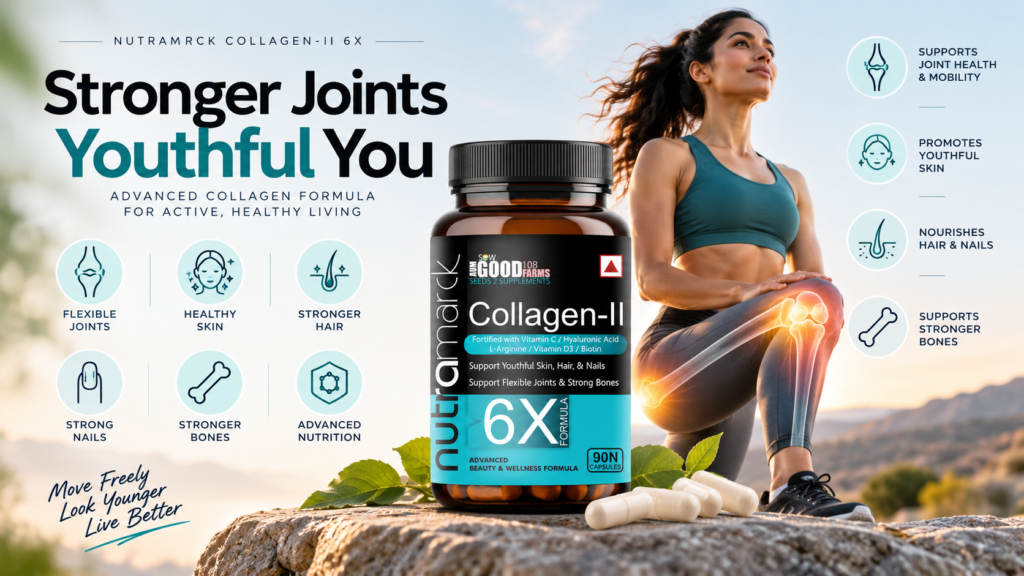
Explore NutraMarck Collagen II 6X Capsules
If your primary interest is a collagen formulation designed around joint, cartilage and connective-tissue wellness, explore the complete formulation of NutraMarck Collagen II 6X Capsules.
Review the ingredients, serving information and directions before deciding whether the formulation is appropriate for your routine.
Explore NutraMarck Collagen II 6X Capsules →
Frequently Asked Questions About Collagen
What are the main benefits of collagen?
Collagen is a structural protein found in skin, cartilage, bones, tendons, ligaments and other connective tissues. Supplemental collagen has been studied particularly in relation to joint and skin outcomes, although results depend on the collagen form and research quality.
What is Type II collagen?
Type II collagen is a collagen type strongly associated with cartilage and is commonly found in joint-focused collagen formulations.
Is Type II collagen good for joints?
Type II collagen is biologically important in cartilage. Clinical research has also investigated collagen-based supplements for joint outcomes, with a recent meta-analysis reporting improvements in pain and function among people with knee osteoarthritis. This does not establish that every Type II supplement treats arthritis.
Which collagen is best for skin?
Much of the clinical research around skin has investigated hydrolyzed collagen peptides, rather than simply any product labelled collagen. Research findings are mixed, particularly when study quality and funding are considered.
Does collagen help with wrinkles?
Some trials and meta-analyses have reported improvements in wrinkle-related or skin parameters, but a 2025 meta-analysis found that benefits were not demonstrated in higher-quality or non-industry-funded subgroups. Evidence therefore remains uncertain.
Can collagen support bones?
Collagen is an important structural component of bone. Bone health, however, also depends on numerous factors including adequate protein, calcium, vitamin D, physical activity and overall health.
Does collagen grow hair?
There is not strong evidence that oral collagen directly causes hair growth or treats hair loss. Marketing claims in this area often exceed available evidence.
What is the best time to take collagen?
There is no universally established best time. Follow the directions of your specific formulation and aim for consistency.
Can men take collagen?
Yes. Collagen is a structural protein found in both men and women. Supplement suitability depends on individual needs and the formulation rather than sex alone.
Can women take collagen?
Yes. Women can use collagen supplements where appropriate, although pregnancy, breastfeeding, allergies, health conditions and medications may warrant professional advice.
Is collagen safe for daily use?
Clinical studies generally report good tolerability for the collagen formulations and study periods investigated, but suitability depends on the product, source, serving and individual.
Final Thoughts
Collagen isn’t simply a beauty trend.
It is a fundamental structural protein present in cartilage, skin, bone, tendons, ligaments and other connective tissues.
But understanding the type and formulation matters.
For joint-focused supplementation, Type II collagen is particularly relevant because of its relationship with cartilage. Research on collagen-based supplements and knee-joint outcomes is encouraging, although evidence from clinical populations should not be converted into promises that supplements prevent or cure joint disease.
For skin, the picture is more complicated. Some meta-analyses report improvements in hydration and elasticity, while newer analyses question whether those effects remain when only higher-quality or independently funded studies are considered.
The smarter way to choose collagen is:
Know the Type → Understand the Formula → Check the Serving → Match It to Your Goal → Keep Expectations Evidence-Based
Interested in reviewing the NutraMarck formulation?
View NutraMarck Collagen II 6X Capsules →
References
- Simental-Mendía M, et al. Effect of collagen supplementation on knee osteoarthritis: an updated systematic review and meta-analysis of randomised controlled trials. Clinical and Experimental Rheumatology.
- Myung SK, Park Y. Effects of Collagen Supplements on Skin Aging: A Systematic Review and Meta-Analysis of Randomized Controlled Trials. American Journal of Medicine.
- Pu SY, et al. Effects of Oral Collagen for Skin Anti-Aging: A Systematic Review and Meta-Analysis.
- Choi FD, et al. Oral Collagen Supplementation: A Systematic Review of Dermatological Applications.
- Rustad AM, et al. Myths and media in oral collagen supplementation for the skin, nails, and hair: A review.
Medical Disclaimer
This article is intended for general educational and informational purposes only. It is not intended to diagnose, treat, cure or prevent any disease. Dietary supplements should not replace a balanced diet, prescribed medication or professional medical advice. Consult an appropriate healthcare professional if you have a medical condition, use medication, are pregnant or breastfeeding.






Add comment