

Magnesium Glycinate Benefits, Dosage & Best Time to Take
Magnesium is an essential mineral involved in hundreds of processes throughout the human body. From normal muscle and nerve function to energy metabolism and bone health, maintaining adequate magnesium intake is important for everyday wellness.
Among the different supplemental forms available, magnesium glycinate—also commonly called magnesium bisglycinate—has become particularly popular for sleep, relaxation and daily magnesium support.
But what does magnesium glycinate actually do? How much do you need? Is it really better to take it at night? And how is it different from magnesium citrate or magnesium oxide?
Here is a science-focused guide to magnesium glycinate benefits, dosage, uses, timing and safety.
What Is Magnesium?
Magnesium is an essential mineral that the body needs to function normally.
It contributes to several important biological processes, including:
- Normal muscle function
- Normal nervous-system function
- Energy metabolism
- Protein synthesis
- Bone health
- Electrolyte balance
- Normal cellular processes
A large proportion of the body’s magnesium is stored in bones, while much of the remainder is found in muscles and other soft tissues.
Because the body cannot manufacture magnesium itself, it must come from food and, where appropriate, supplementation.
What Is Magnesium Glycinate?
Magnesium glycinate is a supplemental form of magnesium in which magnesium is associated with glycine, an amino acid naturally present in the body.
This combination is widely used in modern magnesium supplements and is particularly popular in formulations designed around evening wellness, relaxation and daily magnesium support.
Magnesium Glycinate vs Magnesium Bisglycinate
You will often see two similar terms on supplement labels:
Magnesium Glycinate
Magnesium Bisglycinate
Magnesium bisglycinate more specifically refers to magnesium associated with two glycine molecules.
However, within the supplement industry, the terms magnesium glycinate and magnesium bisglycinate are frequently used interchangeably.
When comparing products, don’t focus only on the wording on the front label. Also check the complete formulation and, importantly, the amount of elemental magnesium provided.
7 Potential Benefits of Magnesium Glycinate

1. Supports Normal Muscle Function
Magnesium contributes to normal muscle function and participates in processes involved in muscle contraction and relaxation.
This makes adequate magnesium intake particularly relevant for physically active people as well as general everyday wellness.
However, muscle cramps or weakness can have many causes, so magnesium supplementation should not automatically be considered a treatment for every muscle-related symptom.
2. Supports Normal Nervous-System Function
Magnesium is involved in nerve signalling and normal neuromuscular function.
This is one of magnesium’s established biological roles.
Its involvement in the nervous system is also one reason magnesium supplements are frequently incorporated into evening wellness and relaxation routines.
3. Supports Normal Energy Metabolism
Magnesium participates in numerous biochemical reactions involved in energy production.
It interacts closely with ATP—the molecule cells use for energy.
This does not mean magnesium acts like caffeine or provides an instant energy boost. Instead, adequate magnesium is part of the body’s normal energy metabolism.
4. Supports Bone Health
Magnesium isn’t only relevant to muscles and sleep.
A substantial amount of the magnesium in the human body is found in bone, and magnesium participates in processes important for maintaining normal skeletal health.
For this reason, magnesium should be considered an important dietary mineral rather than simply a “sleep supplement.”
5. Magnesium Glycinate for Sleep
One of the most frequently searched questions is:
Does magnesium glycinate help with sleep?
Research is developing.
A 2025 randomized, double-blind, placebo-controlled study investigated magnesium bisglycinate supplementation in 155 adults reporting poor sleep.
Participants received magnesium bisglycinate providing 250 mg of elemental magnesium daily or placebo for four weeks.
The researchers reported a statistically significant improvement in insomnia severity compared with placebo, although the magnitude of improvement was modest.
This means magnesium bisglycinate may support sleep quality in some people, but it should not be presented as a sleeping medicine or guaranteed treatment for insomnia.
6. Magnesium Glycinate for Relaxation
Magnesium’s involvement in normal nervous-system and muscle function has contributed to its popularity in relaxation-focused supplements.
Glycine itself also participates in several biological processes.
However, claims that magnesium glycinate instantly eliminates stress or anxiety are stronger than current evidence supports.
It is better understood as nutritional support rather than a sedative.
7. Magnesium for Active Lifestyles
Magnesium is relevant to people who exercise because of its established roles in normal:
- Muscle function
- Energy metabolism
- Electrolyte balance
- Protein synthesis
This does not mean that taking more magnesium automatically improves athletic performance.
Adequate nutrition, hydration, sleep and training remain fundamental.
How Much Magnesium Do Adults Need?
Magnesium requirements vary by age and sex.
According to the U.S. National Institutes of Health Office of Dietary Supplements, recommended magnesium intake for most adults is approximately:
Adult Men: 400–420 mg per day
Adult Women: 310–320 mg per day
These figures refer to total daily magnesium intake from dietary sources, not the amount everyone should obtain from a supplement.
Food should remain an important source of magnesium.
Magnesium Glycinate Dosage: Understand Elemental Magnesium
This is one of the most important things to understand before buying a magnesium supplement.
Suppose a product says:
“Magnesium Bisglycinate 1000 mg”
That does not necessarily mean the supplement provides 1000 mg of elemental magnesium.
Magnesium bisglycinate is a compound containing both magnesium and glycine.
The amount of actual magnesium provided is known as:
Elemental Magnesium
Therefore, when comparing two magnesium supplements, check the nutrition/supplement information rather than simply choosing whichever product displays the largest milligram number on the front.
How Much Supplemental Magnesium Is Too Much?
The U.S. Food and Nutrition Board established an adult upper intake level of 350 mg/day for magnesium from supplements and medications.
There is an important distinction here:
This upper limit applies to supplemental magnesium—not magnesium naturally present in food.
Individual requirements can differ, and medically supervised supplementation may follow different guidance.
Best Time to Take Magnesium Glycinate
Another popular question is:
Should magnesium glycinate be taken in the morning or at night?
There is no scientifically established universal time that everyone must take magnesium glycinate.
Because magnesium glycinate is commonly incorporated into relaxation and sleep routines, many people prefer taking it in the evening.
However, consistency and following the directions of your specific product are generally more important than finding a supposed “perfect” time.
How Long Before Bed Should You Take Magnesium Glycinate?
There is no universally established evidence-based rule requiring magnesium glycinate to be taken exactly 30, 60 or 90 minutes before bed.
If you’re using magnesium as part of an evening routine, follow the directions on your specific supplement.
Avoid assuming that taking it at an exact minute before bedtime guarantees better sleep.
Should Magnesium Glycinate Be Taken With Food?
Instructions vary between formulations.
Some people may find magnesium supplements easier to tolerate when consumed with food.
Follow the directions provided with your supplement, and speak with an appropriate healthcare professional if you are uncertain about how it fits with medications or existing health conditions.
Can You Take Magnesium Glycinate Every Day?
Magnesium is an essential nutrient required every day.
However, needing magnesium every day does not automatically mean everyone needs a daily magnesium supplement.
Whether supplementation is appropriate depends on factors such as:
- Diet
- Age
- Total magnesium intake
- Health status
- Kidney function
- Medications
- Supplement serving amount
More magnesium is not automatically better.
Which Foods Are High in Magnesium?
A balanced diet can provide substantial amounts of magnesium.
Good dietary sources include:
- Pumpkin seeds
- Chia seeds
- Almonds
- Cashews
- Beans and legumes
- Whole grains
- Spinach
- Leafy green vegetables
- Some fortified foods
Supplements should complement a balanced diet rather than replace it.
Magnesium Glycinate vs Magnesium Citrate
Both provide magnesium but use different chemical forms.
Magnesium Glycinate / Bisglycinate: Magnesium is associated with glycine and is commonly found in daily wellness and evening formulations.
Magnesium Citrate: Magnesium is combined with citric acid. It is considered relatively bioavailable and can also have a laxative effect, particularly at higher amounts.
Neither form is automatically the best choice for every person.
Magnesium Glycinate vs Magnesium Oxide
Magnesium oxide contains a relatively high percentage of elemental magnesium by weight.
However, different magnesium compounds have different absorption and gastrointestinal characteristics.
Magnesium oxide is also used in certain antacid and laxative products.
Therefore:
Higher numbers on the front label ≠ automatically better magnesium supplementation.
Look at the complete formulation.
Magnesium Glycinate vs Magnesium L-Threonate
Magnesium L-threonate is another specialized form of magnesium that is frequently marketed in brain-health supplements.
Magnesium glycinate and magnesium L-threonate are chemically different forms.
Claims surrounding specialized magnesium formulations should be evaluated based on evidence for the exact form, dose and intended outcome rather than marketing language alone.
Magnesium Glycinate Side Effects
Magnesium supplements can cause gastrointestinal side effects, especially at excessive supplemental amounts.
Possible effects include:
- Diarrhoea
- Nausea
- Abdominal discomfort
- Cramping
Tolerance can differ according to the individual, serving amount and magnesium form.
Can Magnesium Interact With Medicines?
Yes.
Magnesium supplements can interact with or affect the absorption of certain medicines.
Examples include some antibiotics and other medications.
In some cases, magnesium and medication may need to be taken several hours apart.
If you regularly use prescription medication, consult your doctor or pharmacist before beginning magnesium supplementation.
Who Should Be Careful With Magnesium Supplements?
People with impaired kidney function require particular caution with magnesium supplementation because healthy kidneys play an important role in removing excess magnesium.
Professional guidance is particularly important if you:
- Have kidney disease
- Have an existing medical condition
- Regularly take prescription medicines
- Are pregnant or breastfeeding
- Are considering high-dose supplementation
How to Choose a Magnesium Glycinate Supplement
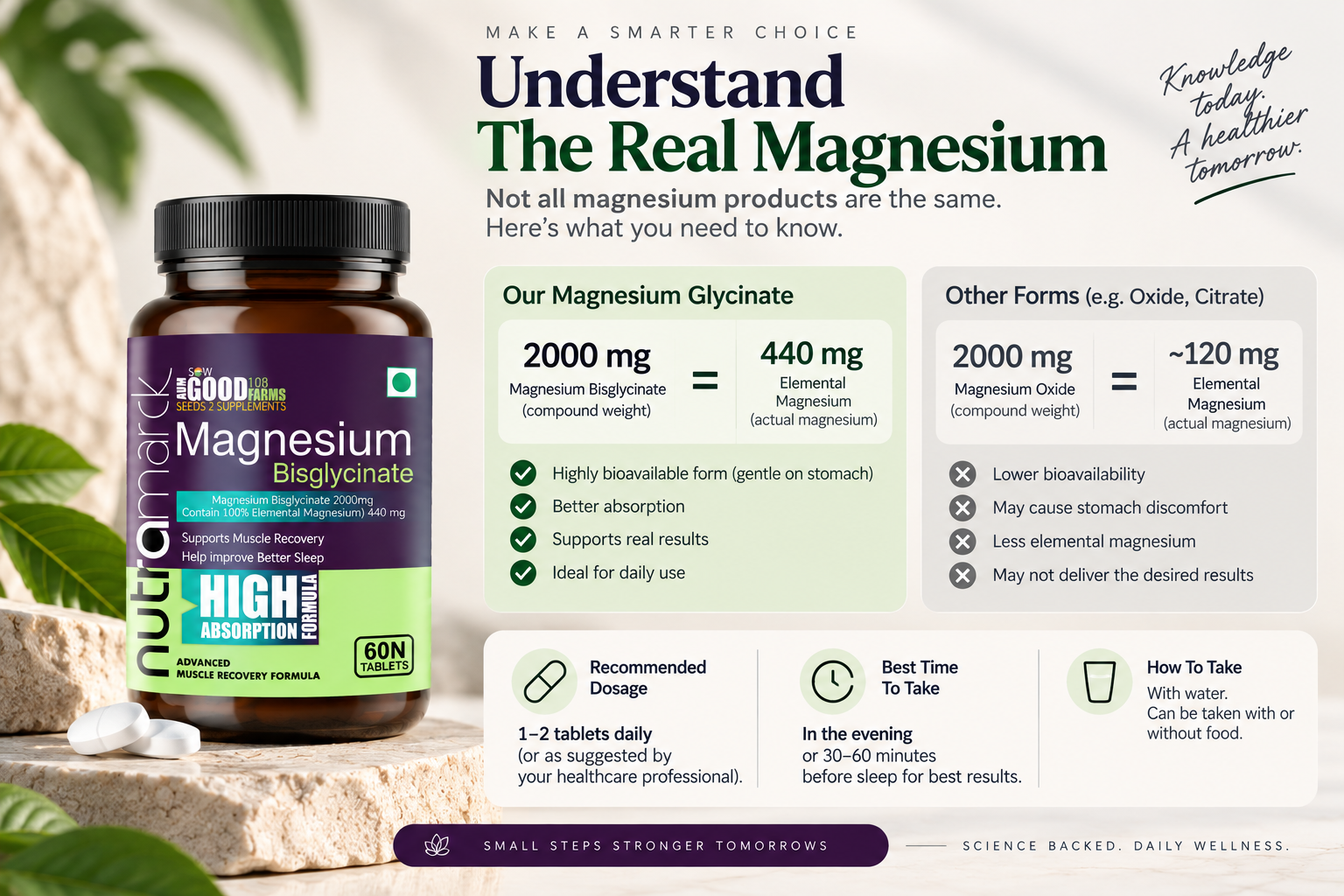
Don’t choose a magnesium supplement simply because the front of the bottle displays the largest number.
Look at these factors instead.
1. Magnesium Form
Check which form of magnesium the product actually contains.
2. Elemental Magnesium
Determine how much actual magnesium the recommended serving provides.
3. Serving Size
Check whether the displayed quantity represents one tablet, multiple tablets or the complete daily serving.
4. Complete Ingredient List
Understand what else is included in the formulation.
5. Transparent Labelling
A good supplement label should make it easy to understand what you’re consuming.
6. Manufacturing & Quality
Consider the manufacturer’s quality standards and product information.
7. Avoid Miracle Claims
Be cautious with products making claims such as:
“Cures insomnia”
“Stops anxiety instantly”
“Guaranteed deep sleep”
“Fixes all muscle cramps”
Nutritional supplementation and medical treatment are not the same thing.
Explore NutraMarck Magnesium Bisglycinate Tablets
If you’re considering adding magnesium to your wellness routine, you can explore NutraMarck Magnesium Bisglycinate Tablets and review the complete product information, ingredients and recommended usage before deciding whether it is appropriate for you.
Explore NutraMarck Magnesium Bisglycinate Tablets →
Always follow the directions provided on the product label.
Frequently Asked Questions About Magnesium Glycinate
What is magnesium glycinate?
Magnesium glycinate is a supplemental form of magnesium associated with the amino acid glycine. Magnesium bisglycinate is a closely related term frequently used interchangeably in supplement labelling.
What are the main magnesium glycinate benefits?
Magnesium contributes to normal muscle and nerve function, energy metabolism and bone health. Magnesium bisglycinate has also been studied in relation to sleep.
Is magnesium glycinate good for sleep?
A 2025 randomized controlled trial found a modest improvement in insomnia severity among adults reporting poor sleep who received magnesium bisglycinate compared with placebo. More research is needed, and it should not be considered a treatment for insomnia.
Is magnesium glycinate the same as magnesium bisglycinate?
The terms are frequently used interchangeably. Bisglycinate more specifically refers to magnesium associated with two glycine molecules.
What is the best time to take magnesium glycinate?
There is no universal best time. Many people prefer taking it in the evening because it fits naturally into their nighttime routine.
How much magnesium do adults need?
Adult men generally require approximately 400–420 mg of total magnesium daily, while adult women generally require around 310–320 mg, although requirements vary by age and other factors.
Is 1000 mg magnesium bisglycinate equal to 1000 mg magnesium?
Not necessarily. Magnesium bisglycinate includes magnesium plus glycine. Look for the amount of elemental magnesium supplied by the serving.
Can magnesium glycinate be taken daily?
Magnesium is an essential daily nutrient, but whether you need daily supplementation depends on your diet, total intake, health status and other factors.
Does magnesium glycinate have side effects?
Supplemental magnesium can cause gastrointestinal symptoms such as diarrhoea, nausea and abdominal discomfort, particularly when excessive amounts are consumed.
Can men and women take magnesium glycinate?
Magnesium is an essential nutrient for both men and women. Individual requirements and the need for supplementation vary.
Final Thoughts
Magnesium glycinate has become particularly popular for sleep, relaxation and muscle wellness, but magnesium’s role in the body goes much further.
It is an essential mineral involved in normal muscle and nerve function, energy metabolism, bone health and numerous biochemical processes.
Research into magnesium bisglycinate and sleep is encouraging, but realistic expectations are important. A supplement should not be presented as a guaranteed solution for insomnia, anxiety or other medical conditions.
When comparing magnesium supplements, remember:
Form → Elemental Magnesium → Serving Size → Quality → Transparency
Want to review the NutraMarck formulation?
View NutraMarck Magnesium Bisglycinate Tablets →
References
- National Institutes of Health, Office of Dietary Supplements. Magnesium — Fact Sheet for Health Professionals.
- Schuster J, Cycelskij I, Lopresti A, Hahn A. Magnesium Bisglycinate Supplementation in Healthy Adults Reporting Poor Sleep: A Randomized, Placebo-Controlled Trial. Nature and Science of Sleep. 2025;17:2027–2040.






Add comment